Net metering boosts your home solar energy savings by enabling you to receive credits for the excess electricity your solar panels produce, which is then sent back to the grid. This mechanism offsets your utility bills, particularly during low production periods, effectively balancing your energy consumption. In many states, you earn credits at or near retail rates, enhancing your savings substantially. Solar payback periods vary widely by location, system cost, and local electricity rates, and can be considerably shorter in states with strong net metering and high utility rates. Such systems not only lower your electricity costs but also contribute to grid stability and sustainability, prompting further examination of their benefits — especially now that the residential federal solar tax credit is changing.
Key Takeaways
- Net metering allows homeowners to earn credits for excess solar energy sent to the grid, reducing electricity bills.
- By offsetting utility costs during low production periods, net metering provides financial relief, especially in winter months.
- The average U.S. residential electricity price rose to 16.5 cents per kWh in 2026, making self-generated solar credits more valuable each year.
- The 30% federal residential solar tax credit (Section 25D) expires for systems installed after December 31, 2026, under the One Big Beautiful Bill Act, making the net metering credit even more important to overall project economics going forward.
- Net metering promotes the adoption of solar systems, contributing to environmental sustainability and reducing reliance on fossil fuels.
What Is Net Metering?
You may be interested



Net metering is a game-changer for homeowners with solar panels, allowing you to send any excess energy your system generates back to the grid. This system not only provides an incentive for solar panel owners like you, but it also promotes renewable energy adoption. Where statewide net metering is supported, you can effectively lower your utility bills by earning credits for the excess energy you produce. Utilizing a specialized energy meter, net metering tracks both your energy consumption from the grid and your generated output. To get started, it’s important to partner with a reputable solar installer who can help you navigate the enrollment process with your local utility company, ensuring the financial viability of your solar investment.
How Net Metering Works

When you harness solar energy for your home, net metering lets you send excess electricity back to the grid, effectively turning your electric meter backward. With a specialized energy meter, you can track both your energy consumption from the grid and the energy produced by your solar panels. During peak production times, typically around midday, your solar energy system may generate excess electricity, allowing you to receive credits in return. These credits offset your utility bill by accounting for the net energy consumed — essentially the difference between what you draw from the grid and what your system generates. In many regions, these credits can be banked, maximizing your energy savings during off-peak periods. Pairing your system with a solar energy monitoring device makes it easier to track exactly how much of your production is being exported versus self-consumed, providing compensation for your solar investment.
Benefits of Net Metering

When you consider the benefits of net metering, you’ll find significant cost reduction opportunities, as it allows you to convert excess solar energy into credits that lower your electricity bills. Additionally, net metering contributes to environmental sustainability by promoting the use of renewable energy sources, ultimately reducing reliance on fossil fuels. Moreover, it enhances grid stability by alleviating transmission costs and facilitating energy generation closer to the consumer, which is increasingly critical in today’s energy landscape.
Cost Reduction Opportunities
One of the most compelling benefits of net metering is its ability to considerably lower your electricity bills. By allowing you to earn credits for excess energy generated by your solar system, net metering enables you to effectively balance your energy consumption, utilizing solar energy during the day and drawing from the grid at night. These credits can be particularly beneficial during winter months when energy costs tend to rise. According to the U.S. Energy Information Administration, the average U.S. residential electricity price climbed to about 16.5 cents per kilowatt-hour in 2026, up from 16.0 cents in 2023 — meaning every kilowatt-hour of solar credit you bank is worth more each year that utility rates continue to rise, helping shorten the overall payback timeline on your system.
Environmental Sustainability Impact
As you consider the broader implications of net metering, you’ll find that it plays an essential role in promoting environmental sustainability. By incentivizing the adoption of solar energy systems, net metering greatly reduces reliance on fossil fuels, thereby lowering greenhouse gas emissions. When you send excess solar energy back to the grid, you actively contribute to renewable energy generation, which is crucial for combating climate change. This practice not only enhances grid stability but also encourages energy efficiency, as homeowners become more mindful of their consumption. Additionally, net metering helps utilities meet renewable portfolio standards set by various states, fostering local and national sustainability initiatives. Ultimately, it supports a shift towards a cleaner energy future, benefiting both you and the environment.
Grid Stability Enhancement
Net metering greatly enhances grid stability by enabling homeowners with solar panels to feed excess energy back into the grid during peak production times. This process reduces overall demand on traditional energy sources, particularly during high-demand periods in summer months. By decreasing reliance on fossil fuels, net metering not only supports environmental sustainability but also mitigates the risk of grid overload. When solar energy is generated at the point of use, it minimizes transmission costs and energy losses associated with long-distance electricity transport, benefiting the entire energy supply system. Utility companies can leverage the surplus solar energy from net metering participants, leading to energy savings and a more balanced, efficient energy supply system that integrates diverse renewable energy sources effectively.
Types of Net Metering
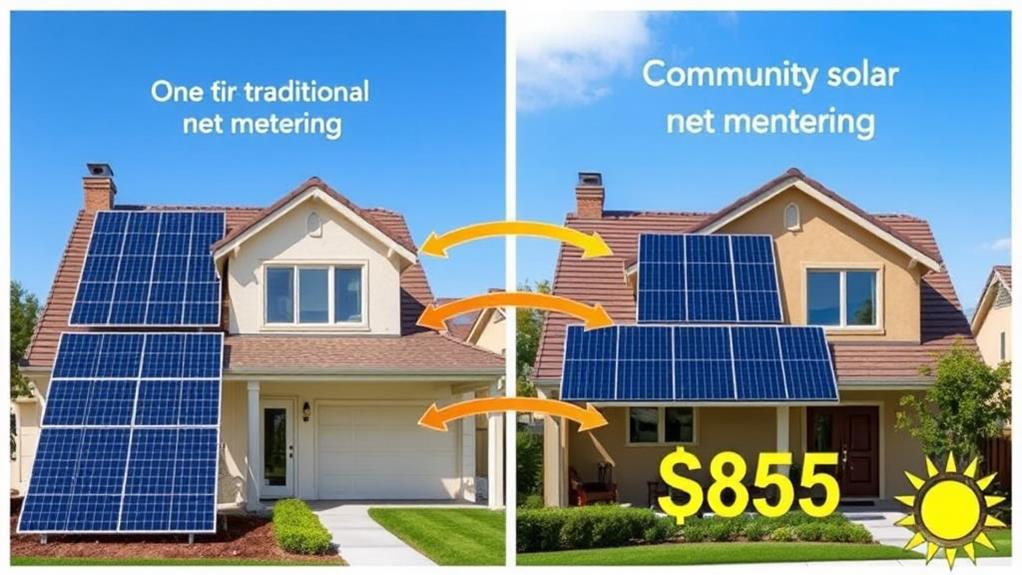
When considering solar energy options, it is vital to understand the different types of net metering systems available. Traditional net metering allows homeowners to receive credits at or near the retail rate for excess energy sent back to the grid, effectively offsetting their electricity costs. In contrast, net billing compensates for excess energy at a lower, avoided-cost or wholesale-like rate, which can be less beneficial. The Buy All/Sell All model entails separate metering for solar production and home consumption, requiring homeowners to sell all generated energy to the utility while purchasing their energy needs at retail rates. Additionally, Virtual Net Metering (VNEM) enables those without onsite solar panels to benefit through community solar projects, thereby receiving credits for their share of the solar energy produced.
Net Metering Availability

Understanding the landscape of net metering availability is essential for homeowners considering solar energy. The large majority of U.S. states have adopted some form of net metering or a “successor” net metering/net billing tariff, but policies, compensation rates, and system-size caps vary widely by state and even by individual utility, according to the Database of State Incentives for Renewables and Efficiency (DSIRE). A handful of states have no mandatory net metering requirement at all, leaving compensation up to individual utilities or state regulators. Some regions also impose limitations, such as capping eligible system sizes or offering reduced compensation rates for exported energy. This disparity in net metering policies can directly affect the financial viability of solar investments, so homeowners should check our state-by-state solar incentives guide and verify current local utility policy before installing.
| Net Metering Policy Type | How Exported Energy Is Compensated |
|---|---|
| Traditional Net Metering | Credited at or near full retail rate |
| Net Billing | Credited at a lower avoided-cost or wholesale-like rate |
| Buy All / Sell All | All solar output sold to utility; power purchased separately at retail rate |
| Virtual Net Metering (VNEM) | Credits allocated to subscribers of a shared community solar array |
| No Mandatory Policy | Compensation set at utility’s discretion, if offered at all |
How to Sign Up

Signing up for net metering is a straightforward process that begins with ensuring your solar panel system is installed and connected to the grid by a qualified installer. To proceed, you’ll need to submit an application to your local utility company, which often requires personal information and proof of your solar installation. It is crucial to have a specialized energy meter installed, as this device will accurately track the energy drawn from the grid and the excess energy you send back. Many reputable solar installation companies can assist you with the necessary paperwork and guidelines for interconnection. Once everything is set up, net metering operates automatically, crediting homeowners for their excess energy production seamlessly, allowing for greater independence and savings. If you’re still weighing whether solar makes sense for your home, our residential solar installation cost guide is a useful starting point.
Financial Implications

When you opt for net metering, you’re not just investing in solar panels; you’re potentially lowering your electricity bills and enhancing your investment returns. By converting excess solar energy into credits, you can offset costs during low production periods, which can meaningfully shorten your overall payback timeline. However, the financial picture has shifted: under the One Big Beautiful Bill Act, the 30% federal residential solar tax credit under Internal Revenue Code Section 25D is being eliminated for systems placed in service after December 31, 2026, according to the ENERGY STAR federal tax credits page and analysis from the Solar Energy Industries Association. That makes maximizing your net metering credits even more important to the overall economics of a home solar investment going forward. (Separate commercial/utility-scale solar tax credits under Section 48E follow a different timeline, with stricter construction-start and placed-in-service deadlines in 2026 and 2027.)
Lower Electricity Bills
As solar panel owners harness the power of the sun, they can enjoy meaningful reductions in their electricity bills through net metering. This system allows homeowners to receive credits for excess energy sent to the grid, ultimately lowering their overall electricity expenses. By utilizing these credits accumulated during peak production times, you can offset costs during low production periods, especially in winter.
| Period | Electricity Bills |
|---|---|
| Summer (High Production) | Noticeably Lowered |
| Winter (Low Production) | Offset with Banked Credits |
| Annual Impact | Meaningful Reduction in Net Utility Costs |
Net metering enhances financial viability by maximizing the return on your solar investment while providing more freedom from rising utility company costs.
Enhanced Investment Returns
The advantages of net metering extend beyond just lower electricity bills; they also play a considerable role in enhancing your overall investment returns. By allowing you to convert excess energy generated by your solar panel systems into credits, net metering effectively reduces your utility bills, amplifying your solar energy savings. The ability to bank excess energy during peak production hours optimizes your energy expenditure, leading to substantial annual savings over the life of the system. With the federal residential tax credit phasing out after 2026, combining net metering benefits with any remaining state and local incentives becomes an even bigger factor in making solar investments economically attractive in the long run.
Common Misconceptions

Addressing common misconceptions about net metering can help homeowners make informed decisions about solar energy. Many believe that net metering provides direct cash payments for excess energy; instead, your electric meter simply runs backward (or a digital equivalent tracks the offset), reducing your electric bills based on net energy consumption. Moreover, net metering isn’t universally available or uniform — policies vary considerably from state to state and utility to utility. Some assume compensation rates are always 1:1 at retail value, yet under net billing or successor tariffs they can be notably lower. Additionally, while net metering might lessen the need for battery storage, it doesn’t eliminate the value of one, especially for backup power during outages. Finally, don’t forget that net metering can apply to other renewable energy systems beyond solar, including small-scale home wind turbines.
| Misconception | Reality | Impact on Homeowners |
|---|---|---|
| Cash payments for excess energy | Meter effectively runs backward, reducing bills | More savings, not direct payments |
| Universally available on identical terms | Policies and rates vary by state and utility | Savings potential differs by location |
| Compensation rates are always 1:1 | Rates can be lower under net billing/successor tariffs | Savings may differ notably by state |
| No need for battery storage | Still valuable for resilience and outage protection | Enhanced energy security during outages |
| Only solar energy qualifies | Other renewable systems may also qualify | Broader options for energy generation |
Frequently Asked Questions
How Does Net Metering Save Money?
Your solar panels turn sunlight into energy credits that offset what you’d otherwise pay the utility. You’ll reduce electricity bills, enjoy real cost savings, and lean on renewable energy to help insulate your household budget from rising utility rates.
Is Solar Net Metering Worth It?
For most homeowners in states with favorable policies, yes. You’ll gain energy credits, lower utility bills, and benefits like greater energy independence, though the value depends heavily on your state’s specific net metering or net billing rules and, going forward, the loss of the federal residential tax credit for systems installed after 2026.
What Does Net Metering Do for Solar?
Net metering converts your solar system’s excess production into bill credits, improving the overall economics of going solar. It supports faster payback, aligns with state policy frameworks, and maximizes the value of every kilowatt-hour your system generates.
Why Are Utilities Sometimes Resistant to Net Metering?
Some utilities argue that retail-rate net metering shifts grid infrastructure costs onto non-solar customers, which is why many states have moved to “net billing” or successor tariffs with different compensation structures. Regulatory changes and rate-design debates can affect the value of credits over time, so it’s worth checking your utility’s current policy before installing.
Did the Federal Solar Tax Credit End in 2026?
Yes, for residential systems. Under the One Big Beautiful Bill Act, the 30% Residential Clean Energy Credit under Section 25D is unavailable for systems installed after December 31, 2026. Commercial and utility-scale solar projects are governed by separate Section 48E deadlines tied to construction start and in-service dates in 2026 and 2027.