To implement saltwater pumped hydro storage systems, we must first select suitable sites, ideally with topographic elevations over 150 meters and stable geology. Next, we design and construct two reservoirs to facilitate seawater transfer using corrosion-resistant pump-turbines that operate reversibly for energy conversion. The system pumps seawater during low demand periods and generates electricity during peak demand by releasing water through a penstock. Thorough feasibility studies and environmental assessments are essential for identifying potential risks and ensuring ecological protection. With global pumped storage capacity having just crossed 201 GW and a further 621 GW of projects in the development pipeline worldwide, saltwater systems are drawing renewed interest as a way to bring long-duration storage to coastal and island grids that lack the freshwater or terrain for conventional pumped hydro. By following these steps, we can develop robust and efficient systems for sustainable energy generation, enabling us to explore further considerations for successful implementation.
Key Takeaways
- Select suitable sites with topographical elevation over 150 meters and geological stability for effective reservoir construction and seawater management.
- Utilize corrosion-resistant materials in pump-turbine units to ensure durability and reliability against seawater challenges.
- Conduct thorough feasibility studies and environmental impact assessments to evaluate risks and minimize ecological disruption.
- Implement a dual-purpose pump-turbine system to efficiently manage energy storage and generation while stabilizing the grid, with round-trip efficiency around 80% according to NREL’s Annual Technology Baseline.
- Engage local communities and stakeholders to foster project acceptance and address environmental concerns throughout the project lifecycle.
Overview of Saltwater Pumped Hydro Storage
You may be interested

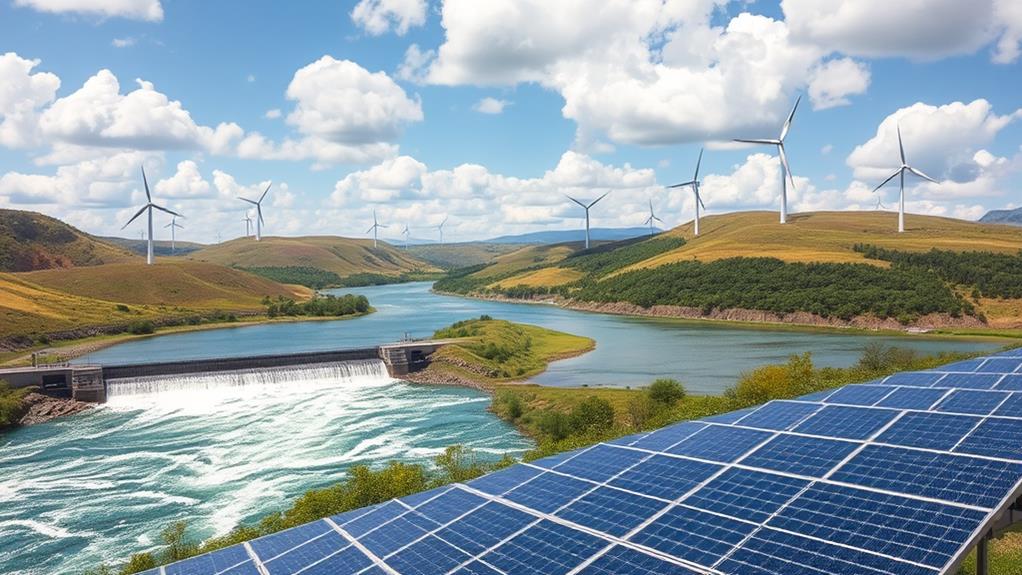
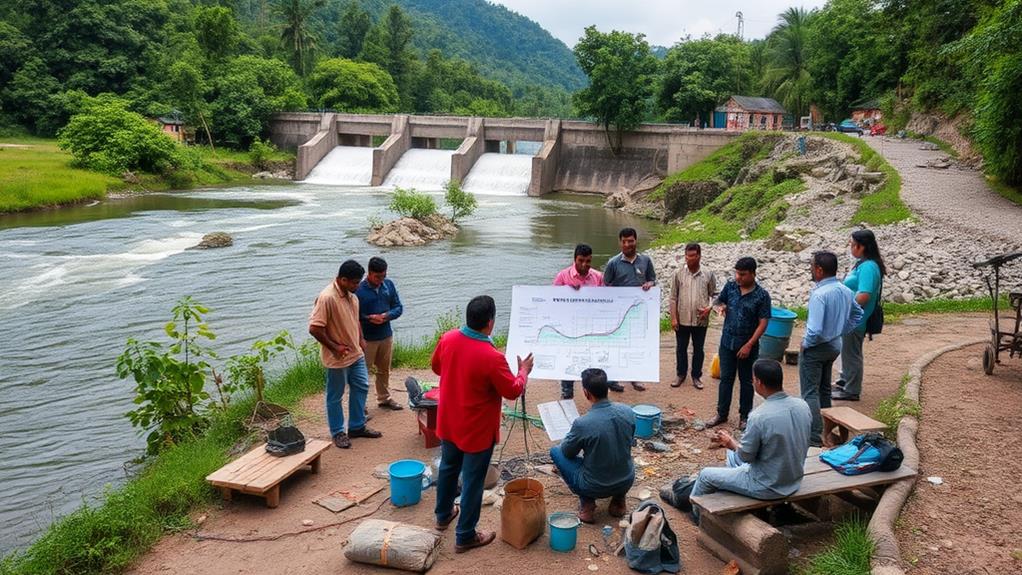
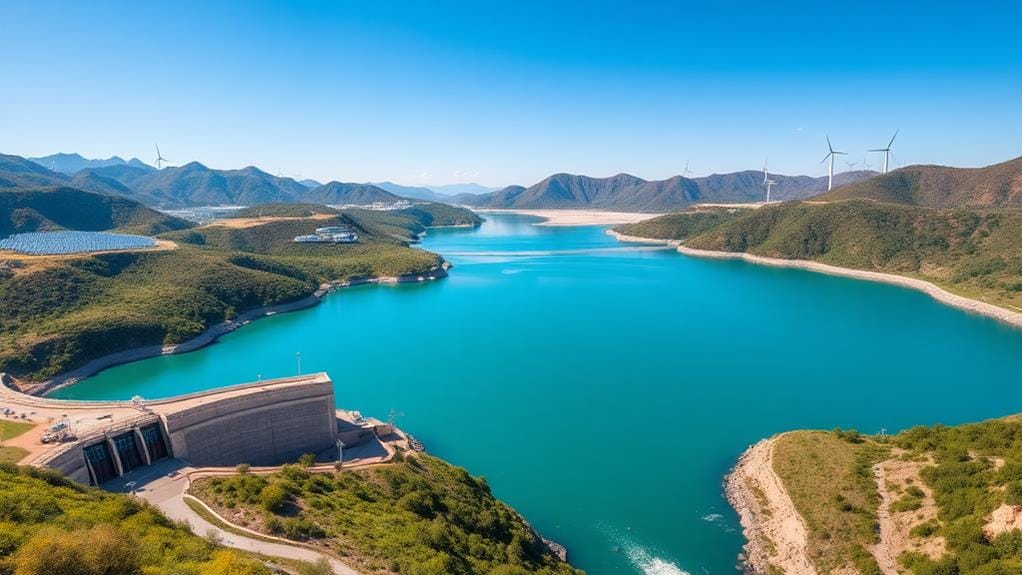
Saltwater Pumped Hydro Storage Systems (S-PSHS) represent an innovative solution for energy storage that utilizes seawater to generate and store electricity. By pumping seawater between two reservoirs at different elevations, S-PSHS can effectively manage energy storage, particularly in coastal regions where freshwater is scarce. This system not only addresses the growing demand for renewable energy but also enhances the economic viability of energy projects in Small Island Developing States (SIDS) such as Cabo Verde, where developers have proposed pumped-storage-with-desalination projects on Santiago Island to pair energy storage with freshwater production. The design minimizes freshwater depletion, ensuring a sustainable approach to energy storage. However, we must acknowledge challenges such as corrosion and saltwater leakage, which require the use of corrosion-resistant materials and secure sealing methods for reservoirs and penstocks, ensuring the system’s reliability and longevity in diverse environments.
Working Principle of the System
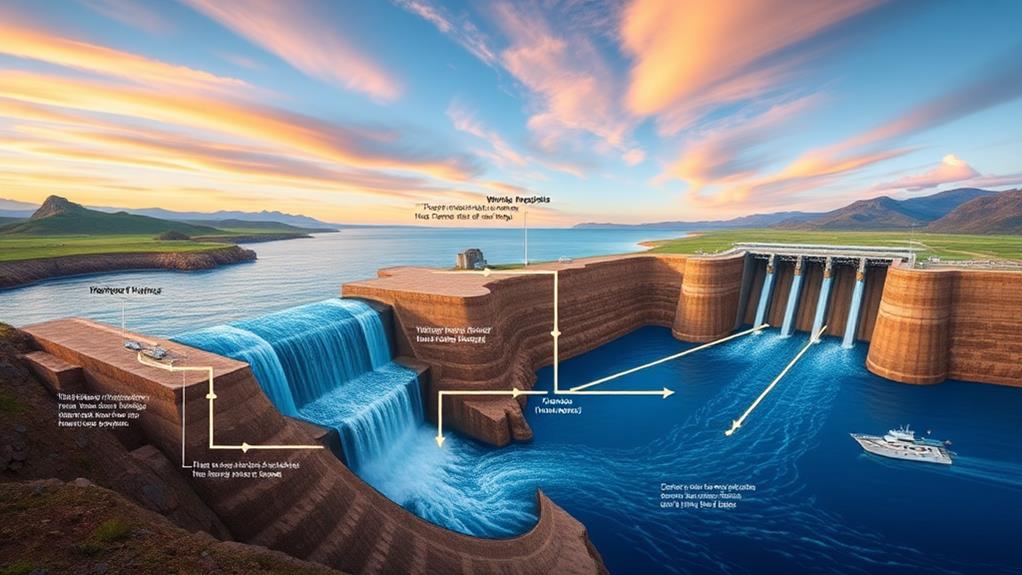
In this section, we’ll examine the working principle of saltwater pumped hydro storage systems, focusing on the energy storage mechanism and the turbine operation process. These systems function by transferring seawater between two reservoirs situated at different elevations, where the gravitational potential energy is harnessed during low energy demand periods. When the demand increases, the stored seawater is released through a penstock, engaging a pump-turbine that simultaneously acts as a pump for energy storage and a turbine for energy generation, thereby facilitating a reversible energy conversion that bolsters grid stability. For a broader look at how storage technologies are priced and sized for renewable projects, see our green energy storage system pricing guide.
Energy Storage Mechanism
Energy storage mechanisms like saltwater pumped hydro storage systems (S-PSHS) work by harnessing gravitational potential energy through a two-reservoir setup. During periods of low demand, surplus electricity is utilized to pump seawater from a lower reservoir to an upper reservoir. When electricity is needed, the seawater flows back down, driving a pump-turbine system that converts this gravitational potential energy into electrical energy. This reversible process greatly aids in balancing the grid, promoting grid stability while integrating renewable energy sources. Key aspects include:
- Dual-purpose pump-turbine system
- Elevation difference for potential energy
- Proven output capacity at pilot scale (the world’s first seawater pumped storage plant, Okinawa Yanbaru in Japan, operated at 30 MW from 1999 until it was decommissioned in 2016)
- Efficient energy retrieval
- Contribution to renewable energy integration
Together, these elements create a reliable energy storage mechanism.
Turbine Operation Process
Understanding how turbine operation works in saltwater pumped hydro storage systems is essential for appreciating their efficiency and effectiveness. The pump-turbine unit serves a dual purpose: it operates as a pump to move seawater to the upper reservoir, and as a turbine when generating electrical energy as water descends. Water from the upper reservoir flows through the penstock, driving the turbine, which converts kinetic energy into mechanical energy, subsequently transformed into electrical energy by the generator. According to NREL’s Annual Technology Baseline, pumped storage hydropower has a central round-trip efficiency estimate of about 80%, a figure the U.S. Energy Information Administration corroborates, reporting that utility-scale pumped storage and batteries together returned roughly 79% of the electricity they stored in recent monitoring. Effective turbine operation is vital for grid balancing, enabling us to store and retrieve electricity in response to demand fluctuations. Additionally, the design must address the corrosive nature of saltwater, employing corrosion-resistant materials for durability and reliability.
Key Components and Infrastructure

A saltwater pumped hydro storage system relies on several key components and infrastructure to function effectively. The system’s efficiency hinges on the following elements:
- Upper reservoir: Designed to contain seawater while preventing leakage.
- Lower reservoir: Collects discharged seawater, critical for energy storage.
- Pump-turbines: Serve dual functions, pumping water up and generating electricity.
- Electric generators: Facilitate the conversion of kinetic energy into electrical energy.
- Penstock: A corrosion-resistant pipe that connects the two reservoirs, ensuring controlled seawater flow.
Understanding the interplay between these components, as well as considering the topography and geology, is essential for maximizing the system’s operational efficiency and energy output. Together, we can implement these systems to harness renewable energy effectively.
Site Selection Criteria
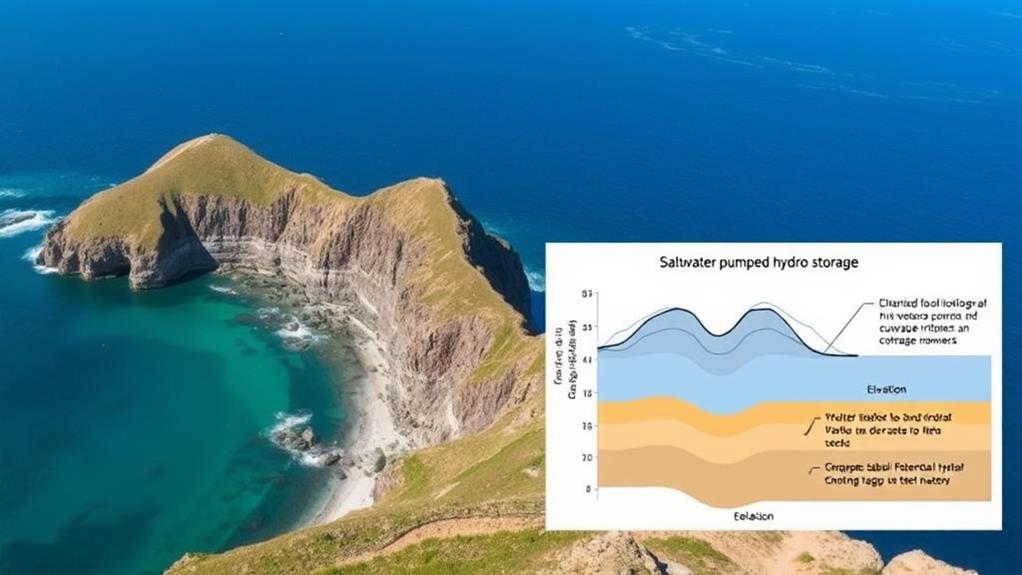
Selecting the right site for saltwater pumped hydro storage systems is fundamental for their success and efficiency. We need to contemplate several significant factors, including topographical elevation, which should ideally exceed 150 meters. Evaluating the geological stability of the site is essential to guarantee reservoir integrity and minimize seawater infiltration risks. Additionally, proximity to a reliable power source aids economic feasibility, especially during low demand periods. Analyzing seawater availability and dispersion patterns is imperative for sustainable operations and mitigating environmental impacts. Here’s a concise overview of the key criteria:
| Criteria | Importance | Considerations |
|---|---|---|
| Topographical Elevation | At least 150 meters | Energy storage capacity |
| Geological Evaluations | Structural integrity | Seawater infiltration |
| Demand for Electricity | Reliable surplus source | Cost-effective pumping operations |
| Economic Feasibility | High capital costs | Project viability |
| Environmental Impacts | Sustainable operations | Minimizing ecological disruption |
On capital costs specifically, NREL’s Annual Technology Baseline estimates closed-loop pumped storage projects built with two new reservoirs — the configuration most seawater systems require — at roughly $3,000 to $4,500 per kilowatt in 2021 dollars, depending on resource class, which is considerably higher than retrofitting a single existing reservoir. Anyone comparing this against other long-duration storage technologies may find our hydroelectric power plant expenses breakdown a useful companion resource.
Feasibility Studies and Environmental Impact
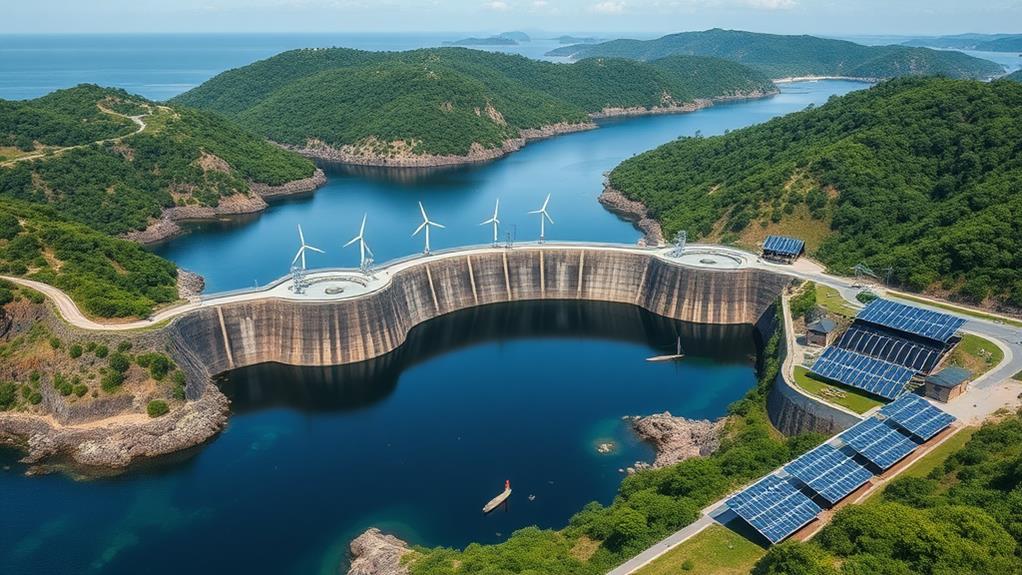
As we begin to explore feasibility studies and environmental impacts for saltwater pumped hydro storage systems, it’s essential that we assess site-specific criteria, such as topography, geology, and hydrology, to guarantee ideal energy storage potential and operational efficiency. Additionally, we must conduct thorough environmental impact assessments to identify and mitigate potential risks, including seawater infiltration and its corrosive effects on materials, as well as the implications for local marine ecosystems. By employing innovative methodologies like GIS-based models, we can pinpoint suitable locations that minimize ecological disruption while maximizing energy capacity, guaranteeing sustainable development of these systems.
Site Assessment Criteria
When evaluating potential sites for saltwater pumped hydro storage systems, we must consider several vital factors to secure feasibility and minimize environmental impact. The right choice hinges on specific criteria that align with our project’s goals, including:
- Topography and geology: A minimum elevation difference of 150 meters is necessary for ideal energy storage capacity.
- Geological stability: Analyzing geological conditions secures reservoir integrity and prevents structural failures.
- Seawater availability: Proximity to a consistent seawater source is essential for operation.
- Environmental impact studies: Thorough evaluations are required to identify risks to local ecosystems and marine life.
- Economic feasibility: Reviewing initial investments and ongoing costs helps determine the project’s viability and sustainability.
Environmental Risk Mitigation
To effectively address environmental risks associated with saltwater pumped hydro storage systems, we must conduct thorough feasibility studies and environmental impact assessments (EIAs). These assessments evaluate potential risks like saltwater infiltration and their effects on local biodiversity, water quality, and sediment transport. By engaging stakeholders, including local communities and environmental organizations, we can gain valuable insights that enhance project acceptance and address concerns. Additionally, employing corrosion-resistant materials in pumps and turbines minimizes maintenance and extends system lifespan, essential in saline environments. Implementing robust monitoring programs will allow us to track long-term ecological impacts, enabling adaptive management strategies to mitigate unforeseen consequences. Together, we can guarantee that our projects not only meet energy needs but also protect our precious ecosystems. For readers weighing the broader tradeoffs of water-based storage against other renewable infrastructure, our overview of the environmental impact of hydroelectric dams covers many of the same ecological considerations.
Challenges in Implementation
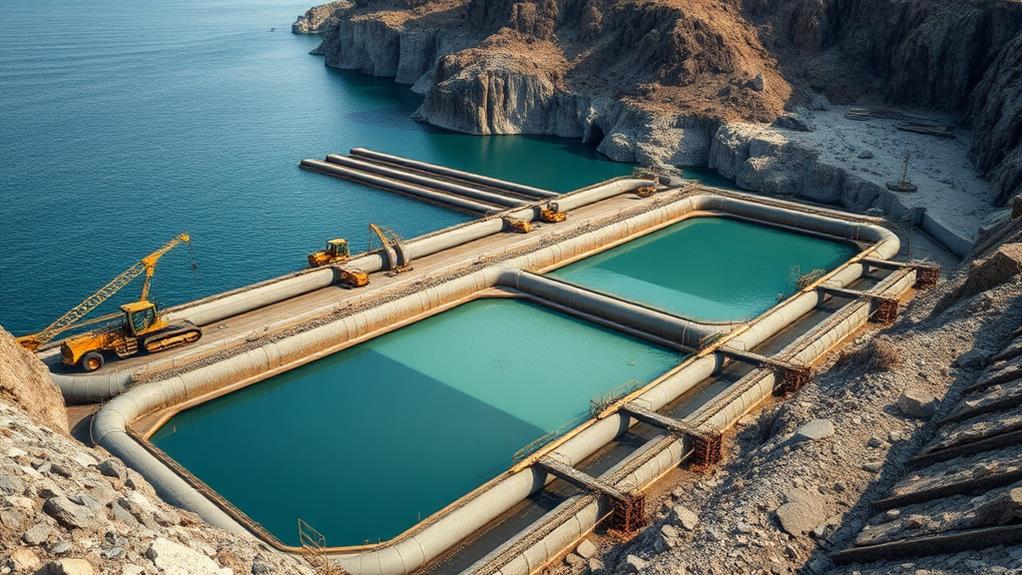
Implementing seawater pumped hydro storage systems presents a range of formidable challenges that can impact their overall success. Key hurdles include corrosion, which necessitates the use of corrosion-resistant materials for pumps and turbines to guarantee long-term operational integrity. Additionally, we face environmental risks linked to seawater leakage, which could harm marine ecosystems, making secure seals essential. The economic feasibility of these projects is often hindered by high initial capital costs — again, on the order of $3,000 to $4,500 per kilowatt for closed-loop configurations per NREL — which can make them less immediately competitive than lithium-ion batteries for shorter-duration applications, even though pumped hydro remains far better suited to storing energy for many hours or days at a time. On the policy side, developers should note that under the One Big Beautiful Bill Act, the federal Section 48E investment tax credit for energy storage projects, including pumped hydro, carries no placed-in-service deadline, unlike the credit for solar generation — though the residential Section 25D credit was terminated for systems placed in service after December 31, 2026. Technical challenges also arise in maintaining reservoir integrity during extreme weather, while site selection is critical, as topographical and geological factors greatly influence project viability. Developers evaluating financing structures may also want to review our comparison of renewable energy financing options, many of which apply across storage and generation projects alike.
- Corrosion management
- Marine ecosystem protection
- Economic feasibility assessments
- Technical integrity assurances
- Strategic site selection
Technological Innovations and Trends
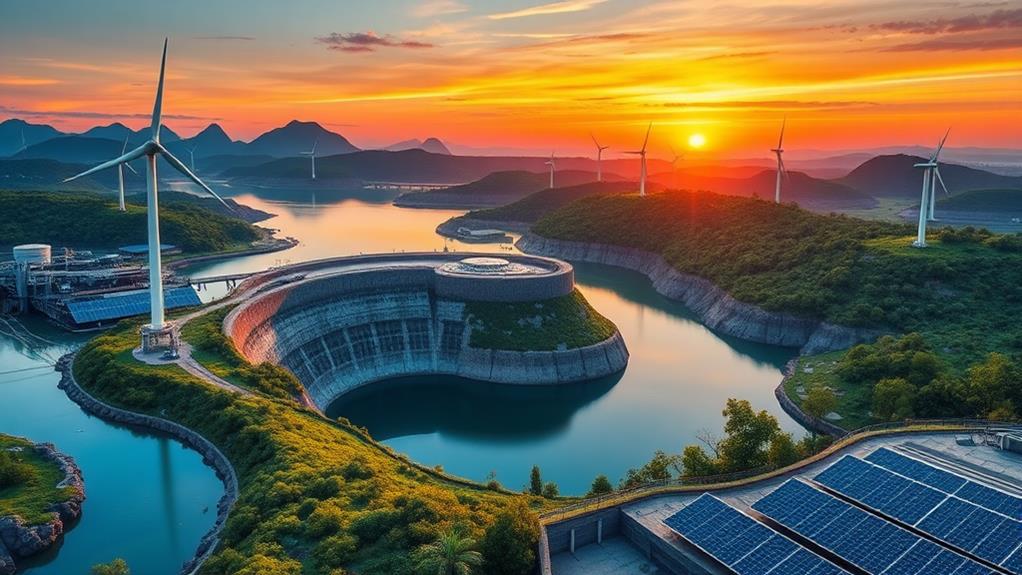
Numerous technological innovations are transforming saltwater pumped hydro storage systems, enhancing their viability and efficiency. The development of corrosion-resistant materials for pump-turbines is essential, ensuring longevity in challenging seawater environments. In addition, integrating axial flow pump-turbines with variable speed drives markedly improves performance, especially in low-head applications typical of saltwater systems. Recent advancements in GIS applications enable us to identify ideal storage sites by analyzing topography and hydrology, streamlining planning efforts. Globally, the pumped storage sector has entered a genuine growth phase: according to the International Hydropower Association’s World Hydropower Outlook, installed pumped storage capacity worldwide passed 201 GW by the end of 2026 after a record 11.7 GW of new capacity was added that year, with a further 621 GW of projects now in the global development pipeline. Ongoing research into grid integration technologies is critical, as it aims to bolster the capability of saltwater pumped hydro systems to support renewable energy sources and stabilize the grid, fostering a sustainable energy future.
Future Opportunities and Collaborations
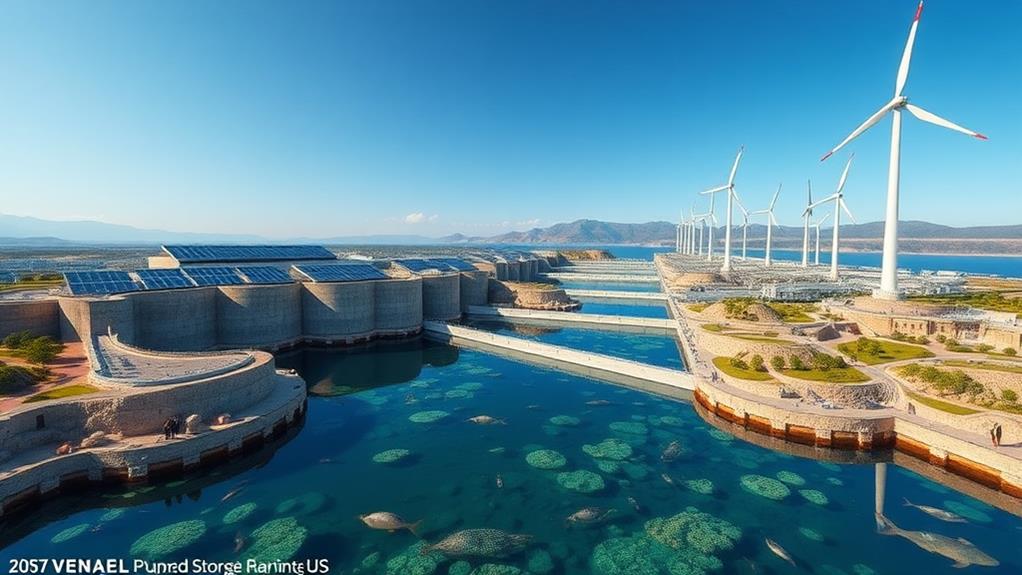
The future of saltwater pumped hydro storage systems holds exciting opportunities for collaboration across various sectors. By joining forces, we can advance our collective sustainability goals while enhancing energy storage solutions. Collaborative initiatives can leverage existing inland hydroelectric plants, optimizing operational efficiency and addressing energy security needs in island and coastal grids. Cabo Verde’s proposed Santiago Island pumped-storage and desalination project is a current example of coastal power authorities exploring combined seawater storage and freshwater production. Additionally, investing in research and development can drive innovation, focusing on corrosion-resistant materials and efficient pump-turbine designs. Engaging local communities and governments will foster public support, ensuring alignment with regional energy needs. Readers interested in how island and remote communities are approaching energy independence more broadly may also find our guide to off-grid living with renewable energy useful.
- Collaboration with desalination facilities
- Partnerships with coastal power plants
- Investment in R&D for innovation
- Leveraging existing hydroelectric plants
- Engaging local communities for support
Frequently Asked Questions
How Much Does It Cost to Build a Pumped Hydro Storage Station?
Costs vary widely by site, but NREL’s Annual Technology Baseline estimates closed-loop pumped storage projects built with two new reservoirs at roughly $3,000 to $4,500 per kilowatt in 2021 dollars, while retrofitting a single existing reservoir can cost significantly less. We must also weigh construction timeline, site selection, environmental impact, maintenance requirements, and financing options together when budgeting a project.
What Is the Formula for Pumped Hydro Storage?
Stored energy in a pumped hydro system is generally calculated as a function of water mass, gravitational acceleration, the elevation difference (head) between reservoirs, and the round-trip efficiency of the pump-turbine system, which NREL puts at roughly 80% for mature pumped storage technology. Together, we must consider site selection, water management, regulatory requirements, and grid integration for an accurate real-world estimate.
How Does a Pumped Hydro Storage System Work?
When we explore how a pumped hydro storage system works, we must consider energy efficiency, environmental impact, system design, operational challenges, site selection, technological advancements, and regulatory considerations to guarantee a successful implementation together.
What Is the Difference Between Hydropower and Pumped Storage?
When we compare hydropower and pumped storage, we see that conventional hydropower focuses on direct, one-way energy conversion from flowing or falling water, while pumped storage is a two-way system that both consumes and generates electricity, aiding grid stability by storing surplus renewable energy and releasing it during peak demand.
Is Saltwater Pumped Storage Still in Use Today?
The world’s first seawater pumped storage plant, Okinawa Yanbaru in Japan, proved the concept technically at a 30 MW scale between 1999 and its decommissioning in 2016, but it was not commercially viable at the time. Interest has since revived, with island and coastal utilities in places like Cabo Verde now evaluating new seawater pumped storage and desalination projects as part of the broader global pumped storage buildout, which the International Hydropower Association reports surpassed 201 GW of installed capacity worldwide by the end of 2026.