When evaluating solar roof tiles versus traditional solar panels, we find several key differences that influence our decision. Traditional panels have an efficiency of 15% to 22%, while solar shingles achieve 14% to 20%, indicating a slight edge for panels. Cost is also a significant factor: traditional systems typically range from $15,000 to $25,000, whereas solar shingles can exceed $40,000. Installation for panels is quicker, usually taking 1 to 3 days versus the longer timeline for roof replacements with solar tiles. Given these parameters, our choice will depend on whether cost and efficiency or aesthetics and integration are our top priorities; further insights will clarify these aspects.
Key Takeaways
- Traditional solar panels are generally more cost-effective, ranging from $15,000 to $25,000, compared to solar roof tiles that can exceed $40,000.
- Efficiency rates for traditional panels reach 15% to 22%, while solar roof tiles range from 14% to 20%.
- Installation of traditional panels is quicker, typically taking 1 to 3 days, while solar shingles require longer due to full roof replacement.
- Traditional solar panels often come with a 25-year warranty, whereas solar roof tiles usually offer a 20-year warranty.
- Aesthetic appeal favors solar roof tiles for design-conscious homeowners, seamlessly integrating with roofs compared to the bulk of traditional panels.
Overview of Solar Energy
You may be interested

Solar energy is increasingly becoming a go-to option for many households and businesses looking to reduce their carbon footprint. With the affordability of solar energy systems on the rise, we can now access various solutions, including traditional solar panels and innovative solar shingles. While installation costs typically range from $15,000 to $25,000 for residential setups, the long-term benefits cannot be overstated. Both options provide substantial energy savings, enhance property values, and qualify for tax credits, making them financially advantageous. Additionally, the lifespan of solar installations generally spans 25 to 30 years, promoting long-term sustainability. By embracing solar energy, we not only decrease our dependence on fossil fuels but also contribute to a cleaner environment and a more sustainable future.
Solar Panels Explained
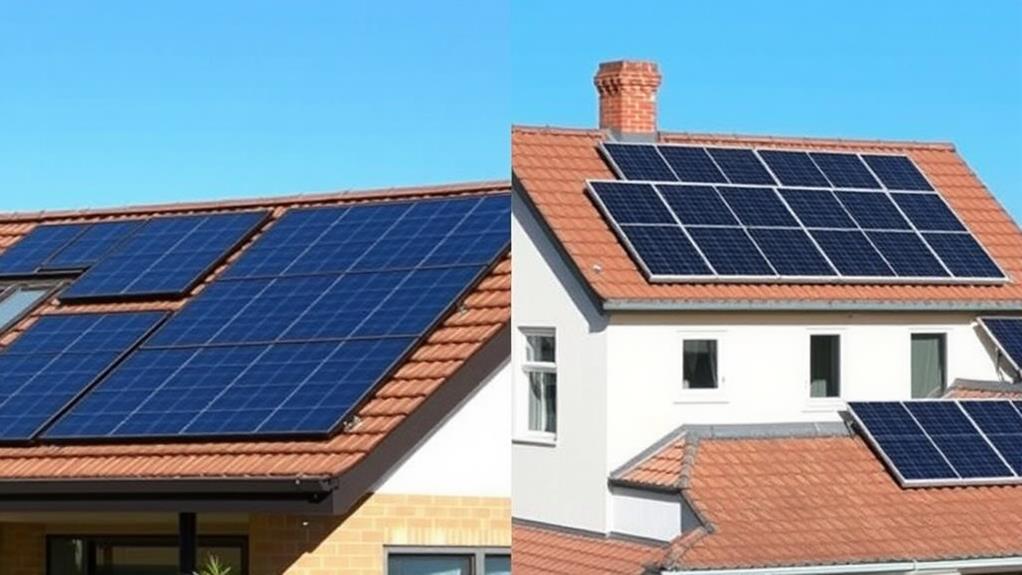
As we explore the options available for harnessing solar energy, traditional solar panels stand out due to their proven technology and effectiveness. These systems utilize photovoltaic (PV) cells to convert sunlight into electricity, typically configured in 60-cell designs for residential use and 72-cell for commercial applications. Here are three key aspects to evaluate:
- Efficiency Rates: Average efficiency ranges from 15% to 22%, with monocrystalline panels generally leading the pack.
- Installed Cost: The average cost for a solar panel system is about $2.85 per watt, translating to $15,000 to $20,000 for a typical 5 kW system before incentives.
- Lifespan and Warranty: Traditional solar panels boast a lifespan exceeding 25 years, often backed by a 25-year product warranty, ensuring reliability and performance.
Recommended Products

【Grade A+ Cells, Up to 25% Efficiency】200 watt solar panel utilizes advanced N-Type A+ Grade solar cells and utilizes advanced 18 BB Silver-Containing Full Welding Busbars technology(which improves the photoelectric conversion efficiency and ensures a longer service life compared to traditional 10BB/12BB solar cells) with an increased cell efficiency of 25% EL tested,outperforming traditional panels.

【N-Type 16BB High-Efficiency Solar Cells】The Callsun 200 watt solar panel is built with advanced N-type solar cells and 16BB busbar technology, delivering up to 25.6% conversion efficiency. Compared to traditional P-type cells, N-type solar panels generate higher power output and better reliability, while the 16BB design reduces hot spots and hidden cracks — ensuring superior performance and a longer lifespan.

[Double the Power, Double the Energy]This package contains the solar panel only. 550W Bifacial solar panels feature a transparent backsheet design, allowing electricity generation from both the front and back, resulting in up to 30% increased efficiency compared to regular solar panels.
Solar Roof Tiles Explained

When it comes to integrating solar technology with home aesthetics, solar roof tiles offer a compelling solution. Known as solar shingles, these innovative products incorporate photovoltaic cells directly into roofing materials, effectively generating renewable energy while providing protection. Their efficiency typically ranges from 14% to 20%, which, while slightly lower than traditional panels, still presents a viable option for many homeowners. Aesthetic appeal is a significant advantage, as they blend seamlessly with conventional roofing materials, making them particularly attractive for homes with strict HOA guidelines. Leading brands like Tesla Solar Roof and CertainTeed Apollo II offer varied designs, yet installation costs can range from $20,000 to over $100,000. Importantly, these tiles qualify for the federal solar tax credit, allowing homeowners to deduct 30% of installation costs.
Recommended Products

Product Includes: a kit containing 4 L-shaped brackets and flash baffles, complete with bolts and hardware, specifically designed for asphalt shingle and composite tile roofs, compatible with most common photovoltaic rails, meeting the installation needs of residential solar modules

Product Includes: a kit containing 12 L-shaped brackets and flash baffles, complete with bolts and hardware, specifically designed for asphalt shingle and composite tile roofs, compatible with most common photovoltaic rails, meeting the installation needs of residential solar modules

Frame-Less Design: Star Cleanedge Series Solar Panel Feature a Frameless Design that prevents dust/water buildup. Rain Self-Cleaning, 0 Maintenance Costs
Cost Comparison
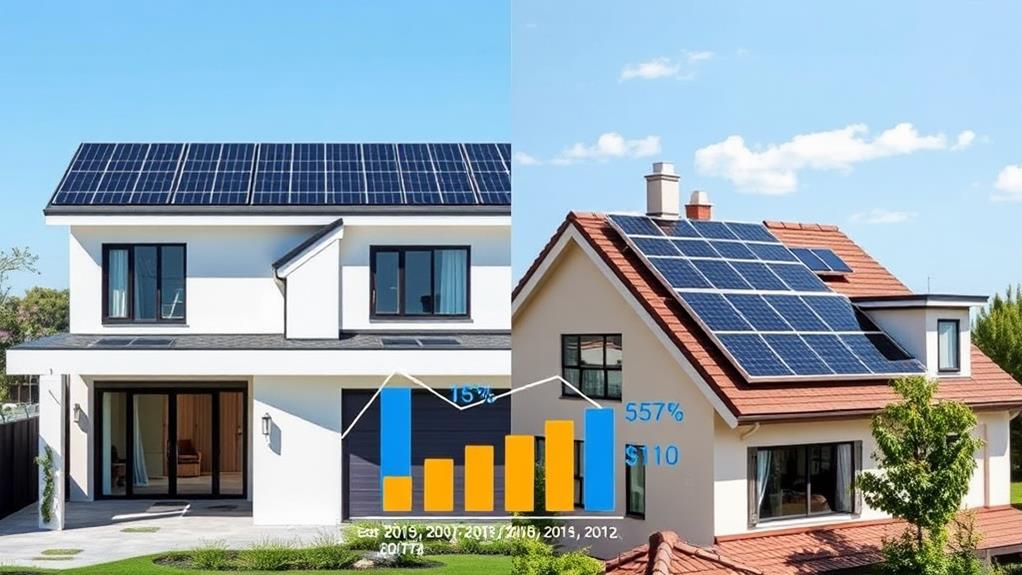
When we compare the costs associated with solar roof tiles and traditional solar panels, we see a significant disparity in initial installation costs, with traditional panels averaging between $15,000 and $25,000, while solar shingles, such as Tesla's Solar Roof, can range from $40,000 to over $100,000. While the upfront investment for solar shingles is higher, their dual functionality as both roofing material and energy generation system suggests a potential for long-term savings through energy efficiency and reduced utility bills. Understanding these cost factors is essential for making an informed decision about which solar solution best aligns with our financial and energy goals.
Recommended Products

- FITS MOST STANDARD SOLAR PANELS : Fits standard 350W ~ 550W solar panels—the most common choice for homes. Securely mounts up to 4 standard solar panels side-by-side. Compatible with aluminum frames 1.18" to 1.38" (30mm to 35mm) thick. Complete hardware included—ready to install.

Minimum number of components
Product Includes: a kit containing 8 L-shaped brackets and flash baffles, complete with bolts and hardware, specifically designed for asphalt shingle and composite tile roofs, compatible with most common photovoltaic rails, meeting the installation needs of residential solar modules
Initial Installation Costs
The cost of installing solar energy systems can vary considerably between traditional solar panels and solar roof shingles. Generally, traditional solar panels range from $15,000 to $25,000, translating to about $3 to $4 per watt. In contrast, solar shingles, like Tesla's Solar Roof, can start at around $25,000 for a 5 kW system, averaging about $5 per watt, leading to higher initial costs. Here's a quick comparison:
- Traditional Solar Panels: Average cost of $15,000 to $25,000.
- Solar Shingles: Average cost can exceed $40,000, often requiring full roof replacement.
- Installation Complexity: Higher installation costs due to specialized contractors and roofing material integration.
These factors contribute to the significant difference in initial installation costs between these two options.
Long-term Savings Potential
After considering the initial installation costs, it's important to evaluate the long-term savings potential of solar energy systems. Traditional solar panels, with costs ranging from $15,000 to $25,000, offer a payback period of 5 to 10 years through substantial energy savings, thanks to efficiency rates of up to 22%. In contrast, solar shingles like Tesla's Solar Roof, while aesthetically appealing, typically cost between $40,000 and $100,000, leading to longer payback periods due to their lower efficiency rates of 14% to 20%. Although both systems qualify for the federal solar tax credit, the higher upfront expenses of shingles may limit immediate financial benefits. Consequently, while solar shingles present a potential long-term investment, traditional panels generally yield superior lifecycle costs and energy savings.
Efficiency Assessment
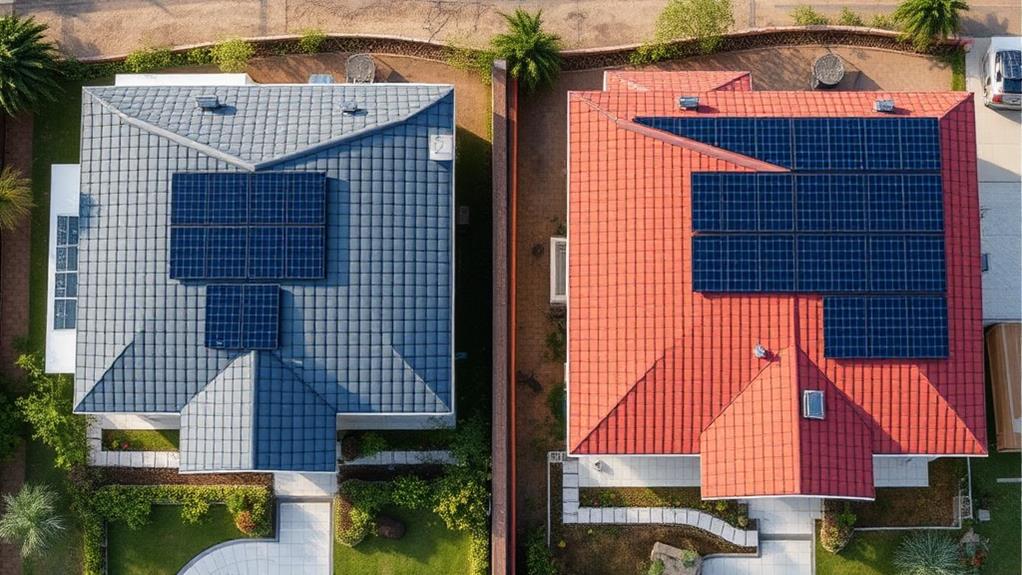
As we assess the efficiency of solar roof tiles versus traditional panels, it's essential to take into account energy conversion efficiency and heat dissipation factors. Traditional solar panels generally achieve an efficiency rate of 15% to 22%, benefiting from airflow beneath them that enhances heat dissipation, which is a significant advantage over solar shingles, typically operating within a 14% to 20% range. Additionally, the ability of solar panels to be repositioned for ideal sun exposure further amplifies their energy capture potential, making them a more effective choice in many scenarios.
Recommended Products
EXTENDED CAMERA FIELD LIFE - Embrace renewable energy, eliminating the need for traditional batteries and ensuring a cost-effective approach to keeping your trail cameras charged; A 3000mAh Li-ion Battery extends the field life of your trail camera

Upgraded High-Efficiency 4 Solar Panels: Equipped with 4 premium solar panels, this solar panel charger charges up to 5 times faster than standard single-panel chargers. It enables direct solar charging even in outdoor settings—keeping your devices powered with green energy anytime, anywhere.

Energy Conversion Efficiency
When it comes to energy conversion efficiency, solar panels generally reign supreme over solar shingles. Traditional solar panels display efficiencies ranging from 15% to 22%, while solar shingles typically fall below 20%. This performance gap can be attributed to several key factors:
- Airflow: Solar panels benefit from airflow beneath them, enhancing cooling and overall efficiency.
- Flexibility: Traditional panels can be repositioned for ideal sunlight capture, maximizing energy production throughout the day.
- Output: For example, CertainTeed solar shingles have an output of 16.1 W/sq ft, compared to Tesla's 15.4 W/sq ft, both of which trail behind conventional panels.
In warmer climates, limited cooling capabilities of solar shingles further reduce their energy conversion efficiency, emphasizing the superior performance of traditional solar panels.
Heat Dissipation Factors
Even though both solar panels and shingles convert sunlight into energy, their heat dissipation capabilities greatly influence their efficiency. Traditional solar panels, benefiting from superior airflow beneath them, typically achieve efficiency rates between 15% to 22%, effectively mitigating excess heat. In contrast, solar shingles, with their integrated design, see efficiency rates ranging from 14% to 20%, but their performance drop under high temperatures can be significant due to limited airflow. This thermal instability affects their energy generation more adversely than that of traditional panels. Consequently, while both solar energy products serve their purpose, the superior heat dissipation of traditional solar panels makes them a more reliable option for maximizing energy output, especially in hotter climates.
Aesthetic Considerations
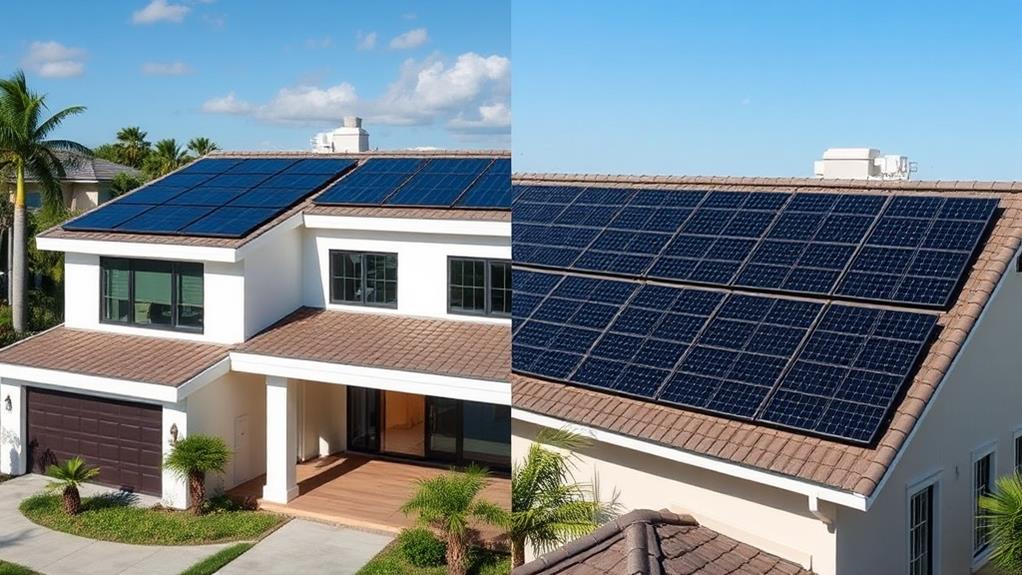
Blending aesthetics with functionality, solar roof tiles present an appealing alternative for homeowners who value both design and sustainability. Unlike traditional solar panels, which can disrupt curb appeal with their bulky appearance, solar shingles feature a low-profile design that complements conventional roofing materials. Their aesthetic integration is particularly beneficial for those in neighborhoods governed by strict HOA guidelines, as they seamlessly meet appearance standards.
Here are three significant aspects of solar roof tiles:
- Customizable Colors: Tailor your roof's look to match your personal style.
- Varied Textures and Styles: Cater to diverse architectural preferences for enhanced visual appeal.
- Enhanced Curb Appeal: Elevate your home's overall design while incorporating renewable energy solutions.
Installation Process
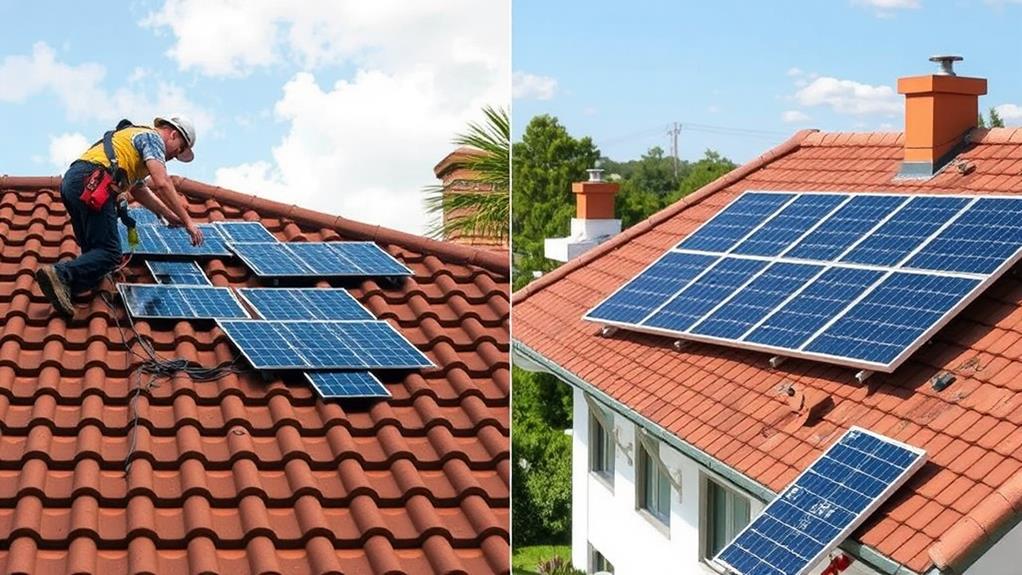
Installing solar roof tiles differs markedly from traditional solar panels, and understanding this process is essential for homeowners considering their options. The installation timeline for solar shingles often extends due to the necessity of a complete roof replacement, while traditional solar panels can typically be installed in just 1 to 3 days. Additionally, the complexity of integrating solar technology with roofing materials necessitates specialized contractors, which can increase labor costs. Both systems require a permitting process, but solar shingles may involve more complicated permits due to their dual function. Here's a quick comparison:
| Aspect | Solar Roof Tiles | Traditional Solar Panels |
|---|---|---|
| Installation Timeline | Longer (varies) | 1-3 days |
| Labor Costs | Higher | Lower |
| Permitting Process | More complex | Straightforward |
Recommended Products

-DIY SOLAR INSTALLATION : Quick and straightforward.Featuring height-adjustable design, it securely fits all standard framed PV panels from 30mm to 35mm thick.Ideal for building off-grid power solutions, it's perfect for cabins, RVs, boats, and homes, and is specifically designed for side-by-side installation of 2 solar panels.

【Professional 10-Panel Mounting Kit】 High-output solution for large solar arrays. Includes 16 high-strength 47.2" rails (forms eight 7.9ft sections), 14 connectors, 16 L-brackets, 10 end clamps, and 26 mid-clamps. Optimized for mounting various arrays: fits up to 15 units of 100W panels (22.8"W), 13 units of 200W panels (26.8"W), or 10 units of 320W panels (34.7"W). Provides a heavy-duty foundation for large-scale energy projects. (Note: Solar panels are not included).
【High-Capacity 13-Panel Mounting Kit】 Industrial-grade solution for large solar configurations. Includes 20 high-strength 47.2" rails (forms ten 7.9ft sections), 18 connectors, 20 L-brackets, 12 end clamps, and 36 mid-clamps. Optimized for mounting various arrays: fits up to 20 units of 100W panels (22.8"W), 17 units of 200W panels (26.8"W), or 13 units of 320W panels (34.7"W). Provides a stable, adaptable foundation for your mounting needs. (Note: Solar panels are not included).
Longevity and Warranty

When it comes to longevity and warranty, both solar roof tiles and traditional solar panels offer impressive lifespans, typically ranging from 25 to 30 years. However, it is crucial to take into account the details that differentiate them:
- Warranty Period: Solar shingles usually come with a 20-year warranty, while traditional solar panels often provide a 25-year warranty against manufacturing defects.
- Durability Factors: The materials used in solar shingles enhance their durability compared to traditional asphalt roofing, potentially extending their lifespan with proper maintenance.
- Performance Longevity: Traditional solar panels may deliver better performance longevity, thanks to their design that allows for maximum airflow and heat dissipation.
Both systems contribute to renewable energy production, but understanding their warranties and durability can help us make informed decisions.
Frequently Asked Questions
Are Solar Tiles as Good as Panels?
Are solar tiles as good as panels? While they offer aesthetic appeal and integrate well, we should consider solar efficiency, cost comparison, and energy output. Ultimately, it's about balancing our values with technology advancements and environmental impact.
How Long Do Solar Roof Tiles Last?
When considering solar tile lifespan, we find they typically last 20 to 30 years. Their installation costs, maintenance requirements, and aesthetic appeal make them appealing, but we should also explore warranty options and performance comparison for informed choices.
What Is the Best Roof Type for Solar Panels?
Did you know homes with solar panels can increase property value by up to $15,000? When choosing roofing material, we must consider durability, maintenance, energy efficiency, and aesthetic appeal to maximize our investment and freedom.
What Are the Cons of Solar Shingles?
When we consider the cons of solar shingles, we face installation challenges, higher costs, and lower energy efficiency. Their aesthetic appeal and long-term performance are tempting, but we must weigh these against maintenance requirements and resale value.