When choosing between solar shingles and solar panels for your roof, consider installation costs, efficiency, and long-term savings. Traditional solar panels now average around $3.03 per watt installed, while integrated solar shingle systems such as Tesla Solar Roof run considerably higher once full roofing components are included — making panels the more economical upfront choice for most homeowners. Efficiency ratings also favor panels, with most residential modules rated between 18% and 23%, and premium monocrystalline panels reaching 22% to 24%, compared to Tesla's solar shingles at roughly 8% to 10%. Installation of solar panels is typically quicker and less complex, allowing for better air circulation and performance. While solar shingles may enhance aesthetic appeal, traditional solar panels offer better long-term savings potential, making them a wise investment. It's also worth noting that the federal tax landscape for solar has changed recently — further insights below will clarify which option, and which incentives, may suit your needs best.
Key Takeaways
- Solar panels generally offer higher efficiency (18%–24%) and better long-term savings compared to solar shingles.
- Integrated solar shingle systems cost considerably more than panels once full roof replacement and non-solar components are factored in.
- Solar shingles provide aesthetic appeal and blend with traditional roofing, which may enhance curb appeal.
- The 30% federal residential solar tax credit (Section 25D) expired for systems placed in service after December 31, 2026, though a similar 30% credit remains available through 2027 for solar obtained via a lease or power purchase agreement (Section 48E, claimed by the installer).
- Maintenance is easier for solar panels, while shingles may require more attention due to environmental factors and limited airflow.
Understanding Solar Energy
You may be interested
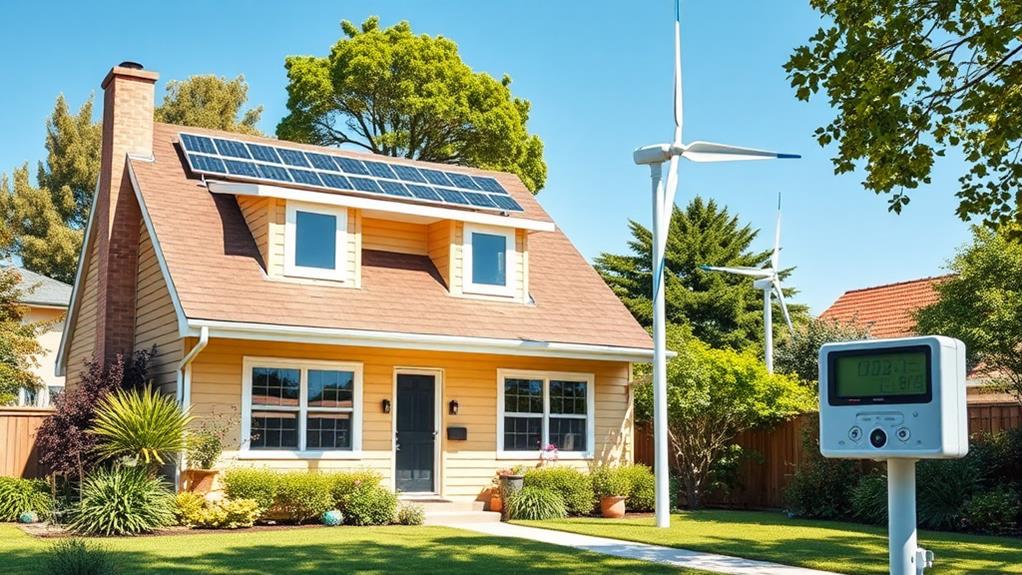

Understanding solar energy is essential, especially as the world shifts towards more sustainable practices. Utilizing renewable energy like solar power can considerably reduce your dependence on fossil fuels and lower carbon emissions. Both solar panels and solar shingles convert sunlight into electricity through the photovoltaic effect, although they differ in design and installation. Traditional solar panels now average about $3.03 per watt installed, while integrated shingle systems like Tesla Solar Roof carry a much higher blended cost because they replace the entire roof surface rather than sitting on top of it. One important update for 2026: the residential federal solar tax credit under Section 25D expired for systems installed after December 31, 2026, under the One Big Beautiful Bill Act. Homeowners financing a purchased system outright can no longer claim that 30% credit directly, though a comparable 30% credit remains available through 2027 under Section 48E when solar is acquired through a lease or power purchase agreement, since in that case the installer (not the homeowner) claims the credit and can pass savings along. Because incentive rules vary significantly by state, it's worth checking state-level solar incentives and the official DSIRE database for what's currently available where you live.
What Are Solar Panels?
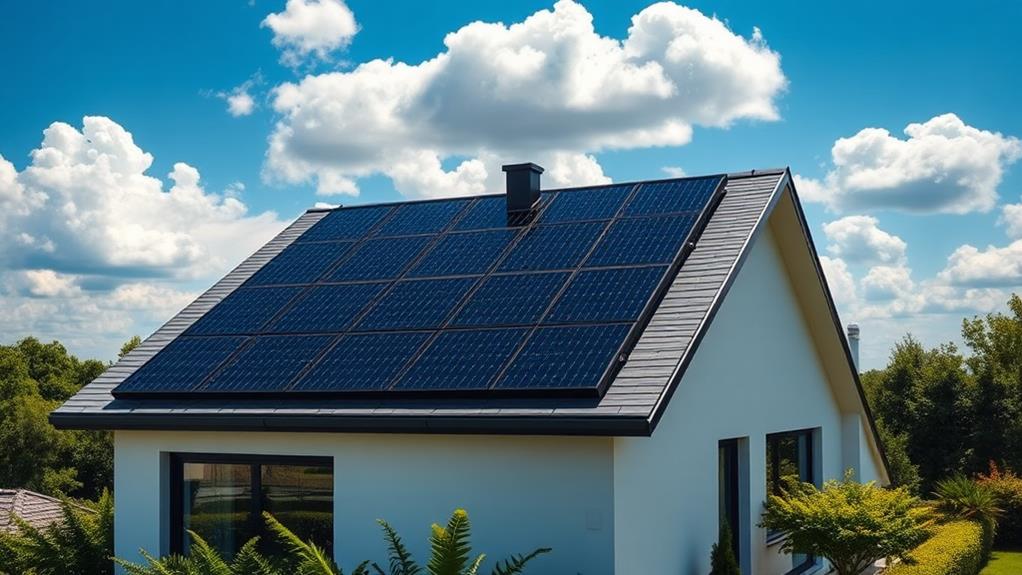
Solar panels are essential components of modern renewable energy systems, designed to convert sunlight into electricity. They consist of multiple photovoltaic (PV) cells, with residential panels typically featuring 60 cells, while commercial options may have 72 cells. The efficiency rates of solar panels have improved in recent years: most residential modules are now rated between 18% and 23% efficiency, and top-tier monocrystalline panels from manufacturers like Maxeon, REC, and LONGi reach 22% to 24%, with select lab models approaching 25%. The average installation cost of a solar energy system is now around $3.03 per watt, with a typical residential system (roughly 7.2 kW) totaling between $21,800 and $26,000 before incentives. Fortunately, these systems usually require minimal maintenance and have a lifespan exceeding 25 years — you can learn more in our guide on how long solar panels actually last. Homeowners considering a purchased system should also check current federal guidance on the Residential Clean Energy Credit before assuming a tax credit applies to your purchase.
Recommended Products

[ Package Content ] 5PC 5Voltage 200mA Polycrystalline Solar Panels with Wire
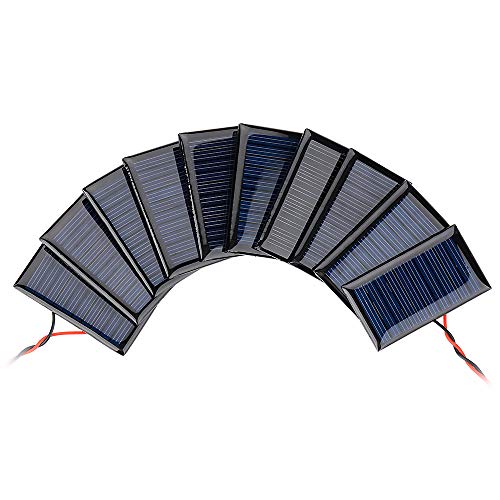
❶【Sufficient Power】All data are actually measured under the condition that the solar light is sufficient. In full sunlight, the voltage will be higher than 5V.

🏞️【Compact 5V Solar Power for DIY Projects】This 5-pack of 1W 5V 200mA mini solar panels helps power small lights, toys, STEM models, and low-current electronics in direct sunlight.
What Are Solar Shingles?
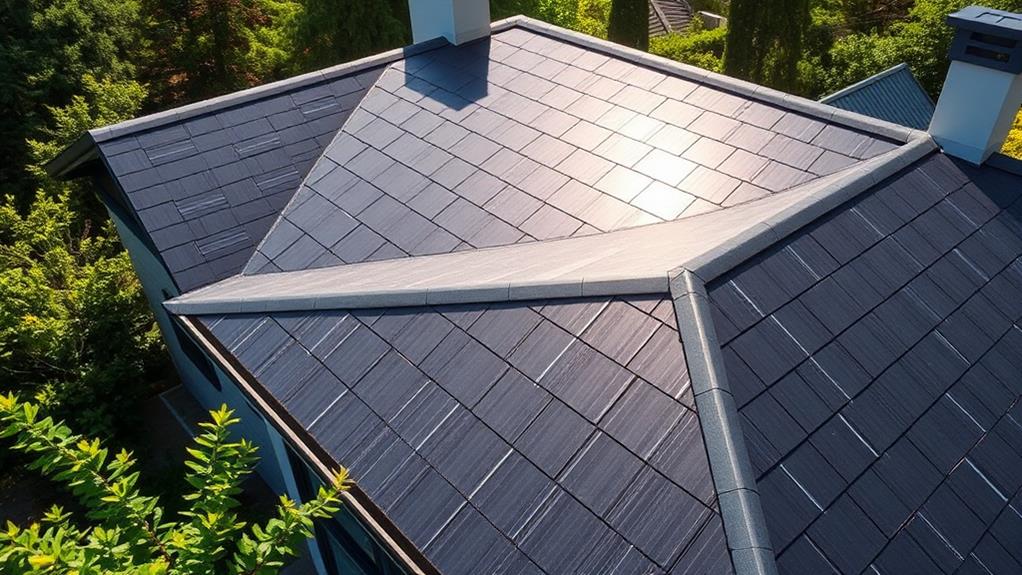
When it comes to innovative roofing solutions, solar shingles stand out by seamlessly combining energy generation with traditional roofing materials. These solar roof tiles integrate photovoltaic cells, allowing them to serve dual purposes as both a weatherproof roof surface and a power generator. Systems like Tesla Solar Roof convert roughly 8% to 10% of sunlight into electricity — notably lower than conventional panels — because the shingle design and limited airflow behind each tile constrain performance. To make up for that lower per-square-foot output, a much larger portion of the roof surface typically needs to be covered with active shingles.
| Feature | Solar Shingles (e.g., Tesla Solar Roof) |
|---|---|
| Efficiency Rating | ~8% – 10% |
| Cost Per Watt (shingles only) | ~$1.80/watt |
| Cost Per Watt (full system incl. non-solar tiles) | ~$5.27/watt |
| Typical Total Installed Cost | ~$100,000 – $110,000 (2,000 sq ft home) |
Recommended Products

Product Includes: a kit containing 4 L-shaped brackets and flash baffles, complete with bolts and hardware, specifically designed for asphalt shingle and composite tile roofs, compatible with most common photovoltaic rails, meeting the installation needs of residential solar modules

Product Includes: a kit containing 8 L-shaped brackets and flash baffles, complete with bolts and hardware, specifically designed for asphalt shingle and composite tile roofs, compatible with most common photovoltaic rails, meeting the installation needs of residential solar modules
Product Includes: a kit containing 12 L-shaped brackets and flash baffles, complete with bolts and hardware, specifically designed for asphalt shingle and composite tile roofs, compatible with most common photovoltaic rails, meeting the installation needs of residential solar modules
Cost Comparison
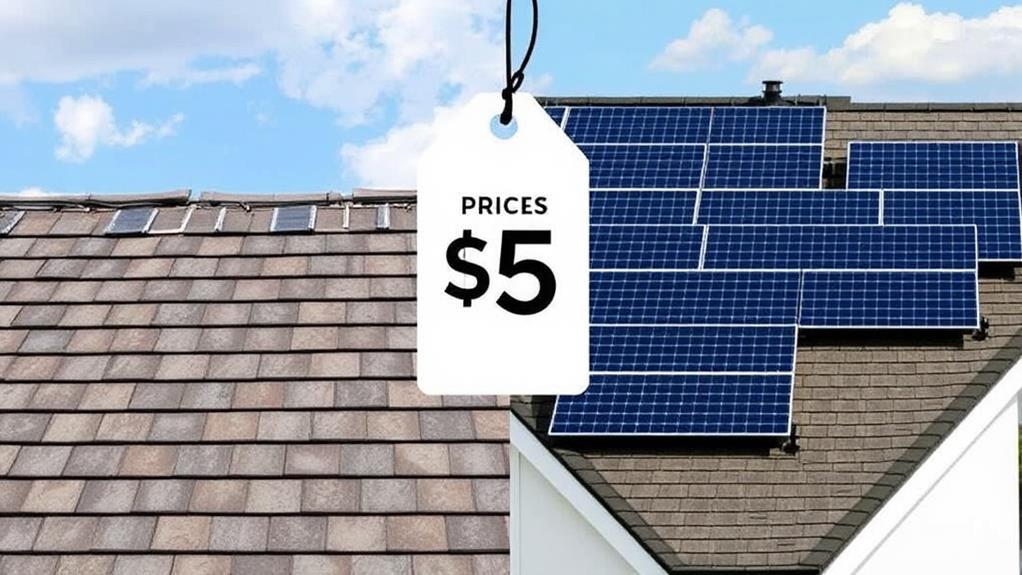
When considering the cost comparison between solar shingles and panels, you'll notice significant differences in initial investments and long-term savings potential. A full Tesla Solar Roof installation on a typical 2,000-square-foot home now runs roughly $100,000 to $110,000, while installing traditional solar panels plus a new roof (roof removal, new roofing, and a ~20 kW-scale solar system) totals closer to $40,000 — meaning shingles can cost $60,000 or more above the combined price of a new roof and standard panels. Traditional panels alone now average about $3.03 per watt, putting a typical 7.2 kW system between roughly $21,800 and $26,000 before any incentives. The higher upfront cost of integrated shingle systems can be partly offset by the fact that they also replace your roofing material, but for pure energy return on investment, panels remain the more cost-effective route. For a deeper cost breakdown by system size, see our guide on residential solar panel installation costs.
Recommended Products

- FITS MOST STANDARD SOLAR PANELS : Fits standard 350W ~ 550W solar panels—the most common choice for homes. Securely mounts up to 4 standard solar panels side-by-side. Compatible with aluminum frames 1.18" to 1.38" (30mm to 35mm) thick. Complete hardware included—ready to install.

[Roof Solar Mounting Brackets] Suitable for metal roof, shingle roof. 10 set of solar mounting brackets can hold up to 4 solar panels.Instead of the very short 4” mini rails, we offer 10x 6” rails, which are 50% longer and more flexible. -- Please notice that this solar panel mounting brackets is compatible to solar panel thickness: 1.37-1.4 inches.

【an easy set-up solar panel roof mounting bracket kit for sloped tin roof】Specially designed to vertically mount one or two solar panels within 76cm long because of the rail length 76cm/29.9 inch. You can extend the rail length by rail splice included in the package. If you need to mount more solar panels, please add the kit quantities as you like. It can also be used to install solar panels onto the tin roofs of a cabin, shed or barn with ease. By L feet, the rail height can be 33-68mm.
Initial Investment Differences
The initial investment for solar shingles is considerably higher than that for traditional solar panels, making it essential to weigh your options carefully. A full Tesla Solar Roof system runs about $5.27 per watt when non-solar tiles and full-roof components are included, compared to roughly $3.03 per watt for standard panels. Because shingle systems replace the entire roof, total project costs of $100,000+ are common on larger homes, versus $21,800–$26,000 for a comparable panel-only system. Since the residential 30% federal tax credit under Section 25D expired for systems installed after December 31, 2026, homeowners purchasing a system outright in 2026 need to budget without that direct credit; those instead using a solar lease or power purchase agreement may still see savings passed through from the installer's 30% Section 48E credit, which remains available through 2027.
Long-Term Savings Potential
Considering the long-term savings potential, traditional solar panels often prove to be the more cost-effective choice compared to solar shingles. With typical installation costs of roughly $21,800 to $26,000 for a 7.2 kW system, panels provide a considerably lower upfront investment than a full shingle roof, which can run $100,000 or more. Panels also benefit from higher conversion efficiency (18%–24% versus roughly 8%–10% for integrated shingles), meaning more electricity is generated per square foot of roof over the system's 25-plus year lifespan. Because the direct 30% federal credit for purchased residential systems ended after 2026, homeowners should factor in state and utility-level incentives and run a full cost-benefit analysis before choosing a system.
Pros and Cons
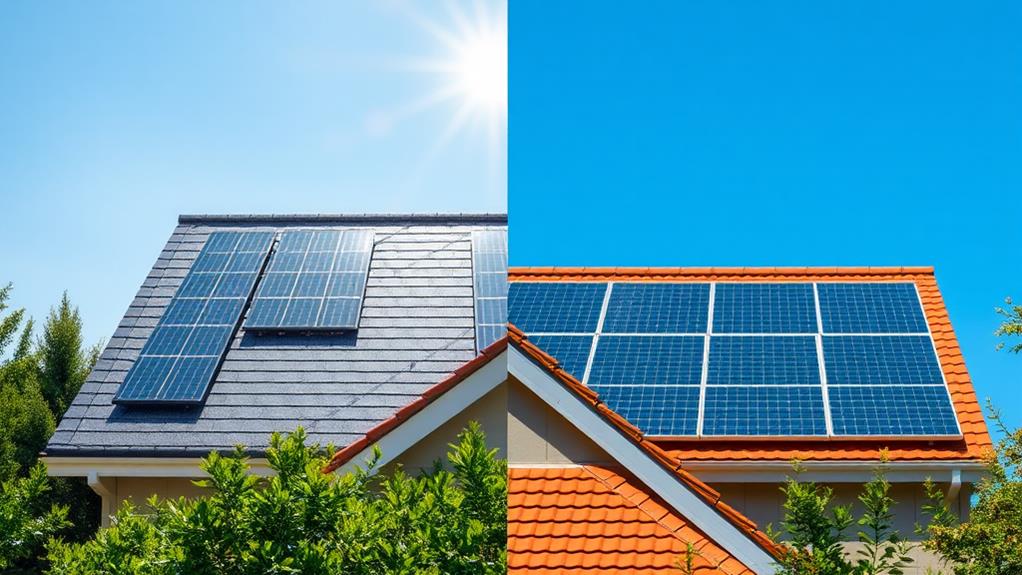
Weighing the pros and cons of solar shingles versus solar panels can help you make an informed decision for your home. Solar shingles offer aesthetic appeal, seamlessly integrating with traditional roofing materials, potentially enhancing curb appeal and resale value. However, their installation cost is considerably higher than solar panels — often $60,000 or more above the combined cost of a new roof plus standard panels. While solar panels boast a higher efficiency rate (18% to 24%) and greater energy production over time, integrated solar shingle systems typically convert only about 8% to 10% of sunlight into usable electricity. Maintenance for solar panels is minimal, but shingles may require more frequent upkeep due to their dual function as roofing material and reduced airflow underneath. Finally, solar panels generally offer a well-established lifespan of 25 to 30 years, and their modular design makes future repairs or panel swaps simpler than replacing an integrated shingle roof.
Recommended Products

Package Contents: this solar panel mounting kit includes 8 Number 2 rails, 12 connectors, 8 adjustable solar end clamps, 16 adjustable solar middle clamps, 16 L shaped brackets, 16 square head bolts and rubber gaskets, 16 bolts and nuts, 8 ground lugs, 16 wire clamps, it can fit 8 solar panels (42 inches wide) or 10 smaller solar panels (26 inches wide
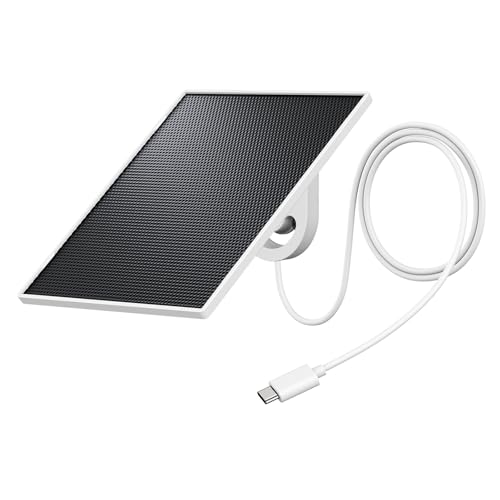
Wide Compatibility: This solar panel comes with 7ft charging cord with Type-C which is designed for rechargeable battery & solar powered outdoor camera wireless. The solar panel charger can provide stable solar energy for your outdoor battery camera, and get rid of the trouble of frequently charging the battery of the camera.

DIY YOUR OWN SMART MODEL----Build your own powered models, solar toys, solar lights, solar displays, charging small DC batteries. It can be used for teaching purpose. Many of our customers come from school, colleague, etc.
Installation Considerations
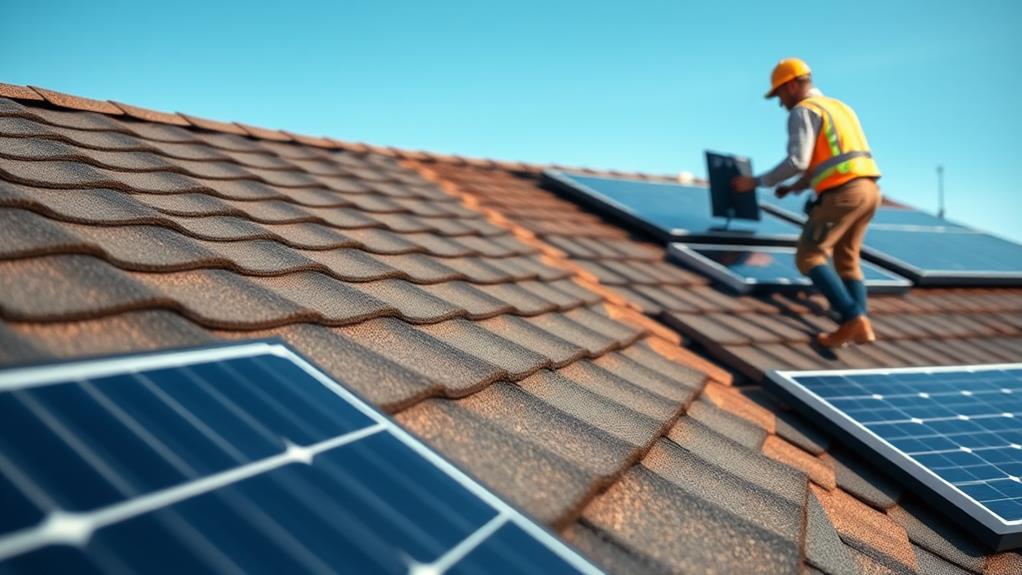
When deciding between solar shingles and panels, installation plays a notable role in your choice. Solar panel installation is generally quicker and easier, typically taking only a few days on an existing roof, allowing for a smoother shift to renewable energy. In contrast, solar shingles are more complex and time-consuming, since they typically require a complete roof replacement rather than a simple add-on, which increases labor and costs substantially. Additionally, while solar panels can be mounted on most existing roofs, solar shingles require the removal of old roofing materials entirely, complicating the installation further. Professional installation is vital for both systems to guarantee peak performance; however, finding skilled contractors certified for solar shingle systems may be more challenging in some areas than finding standard solar installers. Proper positioning is essential for both options, as shading, orientation, and tilt greatly impact their performance.
Recommended Products

WIND-RESISTANT 3-TAB ASPHALT SHINGLES:Designed to withstand winds up to 60 mph, these high-quality roofing shingles provide reliable protection for your roof, whether it's for your house, shed, or other structures.

WIND-RESISTANT 3-TAB ASPHALT SHINGLES:Designed to withstand winds up to 60 mph, these high-quality roofing shingles provide reliable protection for your roof, whether it's for your house, shed, or other structures.

-SOLAR RACKING KIT : Designed for easy setup on shingle or metal roofs, all-in-one system includes pre-drilled aluminum rails,heavy-duty clamps,stainless steel hardware,and waterproof seals. It securely fits all standard 35mm-frame solar panels for reliable off-grid or grid-tied power.
Efficiency and Performance
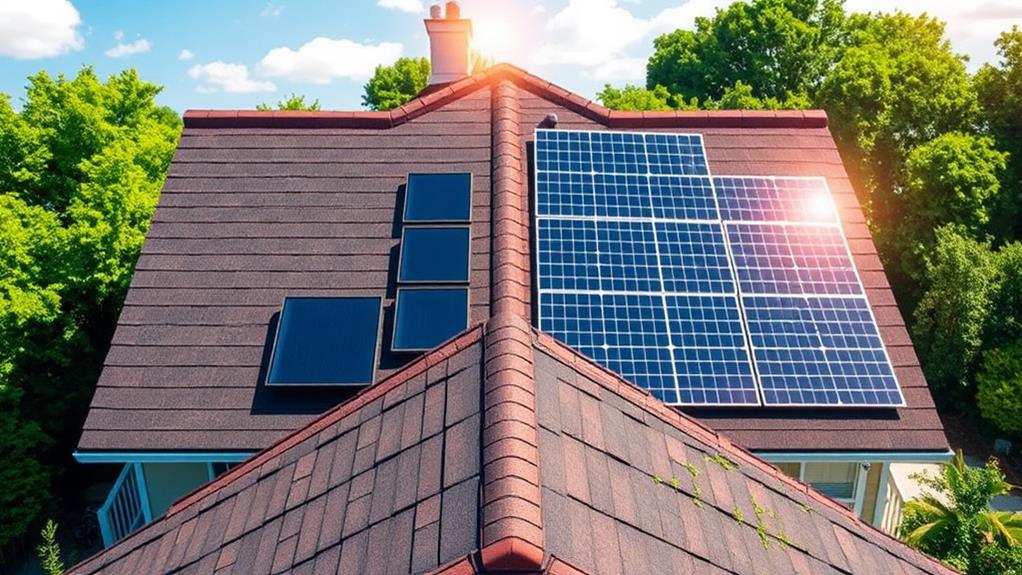
When considering efficiency and performance, it's vital to look at energy conversion rates, heat dissipation factors, and ideal sun exposure for both solar panels and shingles. Solar panels typically outperform shingles with efficiency ratings ranging from 18% to 24%, thanks in part to their superior airflow design that aids in heat management, which is important for maximizing energy output. Integrated solar shingle systems, by contrast, convert roughly 8% to 10% of sunlight into electricity. Both technology types can last 25 years or more, but the performance of solar shingles can be more susceptible to shading and roof orientation, potentially impacting their overall energy generation capabilities.
Energy Conversion Rates
Solar panels typically lead the charge in energy conversion rates, with most residential modules rated between 18% and 23% efficiency, and premium monocrystalline models reaching 22% to 24%. In comparison, integrated solar shingle systems such as Tesla Solar Roof generally convert only about 8% to 10% of sunlight into electricity. The design of solar panels allows for airflow beneath, enhancing energy conversion and overall performance reliability.
| Feature | Solar Panels | Solar Shingles |
|---|---|---|
| Efficiency Rates | 18% – 24% | ~8% – 10% |
| Energy Output | Higher watts/sq ft | Lower watts/sq ft |
| Maintenance | Less required | More affected by heat/airflow limits |
Solar shingles require ideal sunlight exposure, making their performance more susceptible to shading and roof orientation. Consequently, if you seek maximum energy output and efficiency, solar panels remain the better choice for most energy needs.
Heat Dissipation Factors
Heat dissipation plays an essential role in the efficiency and performance of solar energy systems. Solar panels benefit from enhanced airflow beneath them, which facilitates better heat dissipation, especially in hot climates, thereby improving their efficiency and energy production. In contrast, solar shingles, integrated directly into roofing structures, often experience higher operating temperatures due to limited airflow, contributing to their lower real-world conversion efficiency of roughly 8% to 10%, compared to solar panels' 18% to 24%. Ideal sunlight exposure is vital for solar shingles, as their fixed installation restricts repositioning. Additionally, shading, orientation, and tilt can affect both systems, but solar panels generally achieve higher energy output per square foot due to superior heat management capabilities.
Optimal Sun Exposure
Effective energy production relies heavily on ideal sun exposure, which greatly impacts the efficiency and performance of both solar panels and shingles. When considering best sun exposure, you'll find several key factors:
- Efficiency Rates: Solar panels typically achieve 18% to 24%, while integrated solar shingle systems reach roughly 8% to 10%.
- Installation Flexibility: Solar panels can be adjusted post-installation to maximize sunlight capture, whereas solar shingles are permanently affixed as part of the roof.
- Impact of Shading and Orientation: Solar panels can be installed on various roof types and angles, enhancing energy output, while the fixed position of solar shingles may limit performance based on roof orientation.
Ultimately, for maximum sunlight capture and energy output, solar panels generally outperform solar shingles, particularly in high-exposure areas.
Aesthetic Appeal
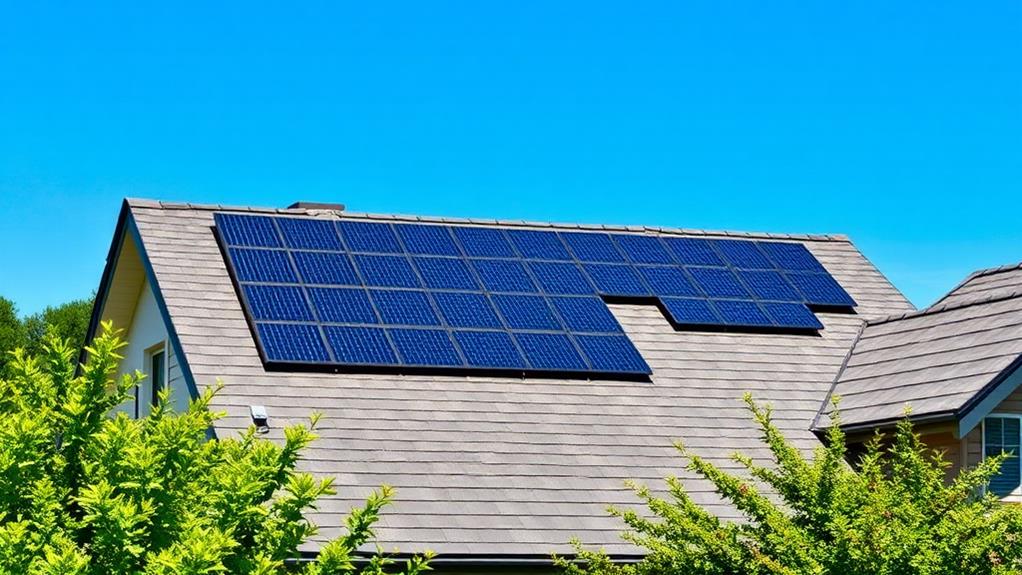
When it comes to enhancing the aesthetic appeal of your home, solar shingles offer a seamless integration that traditional solar panels simply can't match. Designed to resemble conventional roofing materials, solar shingles maintain the harmonious look of your roof while generating energy. This characteristic can boost your home's curb appeal and property value, particularly as they blend effortlessly with various architectural styles. Furthermore, as a homeowner, you'll appreciate that solar shingles often comply with homeowners association regulations that restrict visible solar panel installations, making them a more desirable option in certain neighborhoods. Even standard solar panel systems have been shown to positively affect resale value, so aesthetic considerations should be weighed alongside the significant cost premium that shingle systems currently carry.
Frequently Asked Questions
Do Solar Shingles Work as Well as Panels?
No — while solar shingles offer strong aesthetic appeal and have improved technologically, they generally lag well behind traditional panels in efficiency and energy output, with integrated systems like Tesla Solar Roof converting roughly 8% to 10% of sunlight versus 18% to 24% for standard panels. Consider installation complexity, maintenance requirements, durability, and total cost before deciding.
Is the Federal Solar Tax Credit Still Available in 2026?
Not for homeowners purchasing a residential system outright. The 30% Section 25D Residential Clean Energy Credit expired for systems placed in service after December 31, 2026, under the One Big Beautiful Bill Act. However, a comparable 30% credit under Section 48E remains available to businesses and to third-party owners through 2027, so homeowners using a solar lease or power purchase agreement may still see the savings passed through in lower payments. Check the IRS Residential Clean Energy Credit page and your state's listing on DSIRE for current details.
How Much Does a Solar Roof Cost Vs Panels?
An integrated solar shingle roof, such as Tesla Solar Roof, typically costs $100,000 or more for a mid-size home, versus roughly $21,800 to $26,000 for a standalone panel system, or around $40,000 if you're also replacing the roof and adding standard panels. Don't forget to factor in financing options, maintenance requirements, and resale value for your investment — see our financing comparison guide.
What Is the Best Type of Roof to Put Solar Panels On?
The best roof for solar installation balances durability and energy efficiency. Consider roof orientation, shading impact, and structural condition. Weigh maintenance requirements and installation complexity against cost-effectiveness for ideal environmental benefits and long-term savings.
Are Solar Shingles Worth the Extra Cost?
For most homeowners focused purely on energy savings and payback period, traditional panels remain the better financial choice given their higher efficiency and dramatically lower installed cost. Solar shingles can make sense if aesthetics, HOA restrictions, or a simultaneous full roof replacement are priorities that outweigh the substantial cost premium.