
To manage geothermal heat pump installation costs, start by researching system options and selecting the most suitable design for your property. Gather multiple quotes from contractors to guarantee competitive pricing, and analyze them for detailed breakdowns of costs, including permits. Schedule your installation during off-peak seasons to benefit from reduced labor costs and potential contractor discounts. Act quickly on financial incentives, since the 30% federal residential tax credit under Section 25D expired for systems placed in service after December 31, 2026, and check state and utility rebates that may still be available to offset expenses. Prioritize investing in ENERGY STAR certified equipment for long-term savings while considering ongoing maintenance for peak efficiency. Understanding site-specific conditions can further enhance cost management strategies. More insights await.
Key Takeaways
- Gather multiple quotes from local contractors to ensure competitive pricing and informed decision-making on installation costs.
- Confirm which financial incentives still apply to you, since the federal 30% residential credit (Section 25D) expired after December 31, 2026 for new installations.
- Schedule installations during off-peak seasons to benefit from lower labor costs and potential contractor discounts.
- Request detailed cost breakdowns from contractors to understand labor, materials, permits, and other associated expenses.
- Conduct a thorough site assessment to identify geological conditions and accessibility, preventing unexpected labor costs during installation.
Research System Options
You may be interested
When diving into geothermal heat pump options, it’s essential to understand the different system types available. You’ll find closed-loop and open-loop geothermal heat pump systems, each suited to varying home sizes and local climates. According to current 2026 pricing guides, a full geothermal heat pump installation typically ranges from $10,000 to $30,000, with total project costs (including drilling and loop fields) reaching as high as $12,000 to $45,000 depending on loop type, soil composition, and drilling depth. Horizontal closed-loop systems tend to be more budget-friendly if you have ample land, while vertical loops, which can require drilling to depths of up to 400 feet, generally cost more. Local geological conditions matter too, since soil type and moisture can complicate drilling and raise expenses. Because the federal residential tax credit under Section 25D expired for systems installed after December 31, 2026, it’s worth checking our guide to state-level clean energy incentives and consulting the DSIRE database for state and utility programs that may still reduce your upfront cost. This knowledge empowers you to make informed decisions while optimizing your investment in geothermal technology.
Recommended Products

Gather Multiple Quotes

When you’re looking to install a geothermal heat pump, gathering multiple quotes from different contractors is essential for comparing installer estimates and ensuring you receive competitive pricing. Each contractor’s assessment may vary based on local expertise and site-specific conditions, which can greatly impact the overall cost, typically ranging from $10,000 to $30,000 for a full system, or up to $45,000 for larger or more complex installations. By requesting detailed breakdowns of labor, equipment, and materials in their proposals, you can make an informed decision that aligns with both your budget and installation requirements.
Recommended Products

WHOLE HOUSE REPLACEMENT: 10x17x2 air filters for your furnace, air conditioner, or heat pump enhance HVAC system efficiency and support a healthy lifestyle (actual size: 9.69" x 16.56" x 1.75")
WHOLE HOUSE REPLACEMENT: 20x26x5 air filters for your furnace, air conditioner, or heat pump enhance HVAC system efficiency and support a healthy lifestyle (actual size: 20.00" x 25.88" x 4.88")
WHOLE HOUSE REPLACEMENT: 21x24.5x5 air filters for your furnace, air conditioner, or heat pump enhance HVAC system efficiency and support a healthy lifestyle (actual size: 20.63" x 24.13" x 4.38")
Compare Installer Estimates
Gathering multiple quotes from different geothermal heat pump installers not only helps you understand the average installation costs but also enables you to pinpoint the best deal for your specific needs. By comparing installer estimates, you can assess variations in labor and material costs, which typically range from $10,000 to $30,000, depending on site conditions and local geology. Request detailed breakdowns of equipment, labor, and additional costs, such as permits, to avoid unexpected expenses. Additionally, inquire about the contractor’s qualifications and experience, as skilled installers may reduce costly errors. Some installers also provide financing options — worth comparing against other green energy financing options — since the federal 30% tax credit under Section 25D is no longer available for systems placed in service in 2026 and beyond.
Consider Local Expertise
Considering local expertise can be a game-changer in your geothermal heat pump project. By gathering multiple quotes from local contractors, you can gain insights into installation costs that typically range from $10,000 to $30,000. Local installers often understand regional geology, which affects drilling and installation expenses, guaranteeing accurate estimates. Here’s why you should leverage local expertise:
- Tailored Quotes: Local contractors provide site-specific assessments, addressing unique challenges.
- Faster Permitting: Familiarity with local regulations can expedite necessary approvals, reducing timelines.
- Quality Comparison: Engaging multiple installers allows you to evaluate the quality of equipment and labor, enhancing long-term efficiency.
Ultimately, leveraging local expertise not only helps manage installation costs but also guarantees your geothermal heat pump system operates at its best.
Plan for Off-Peak Installation
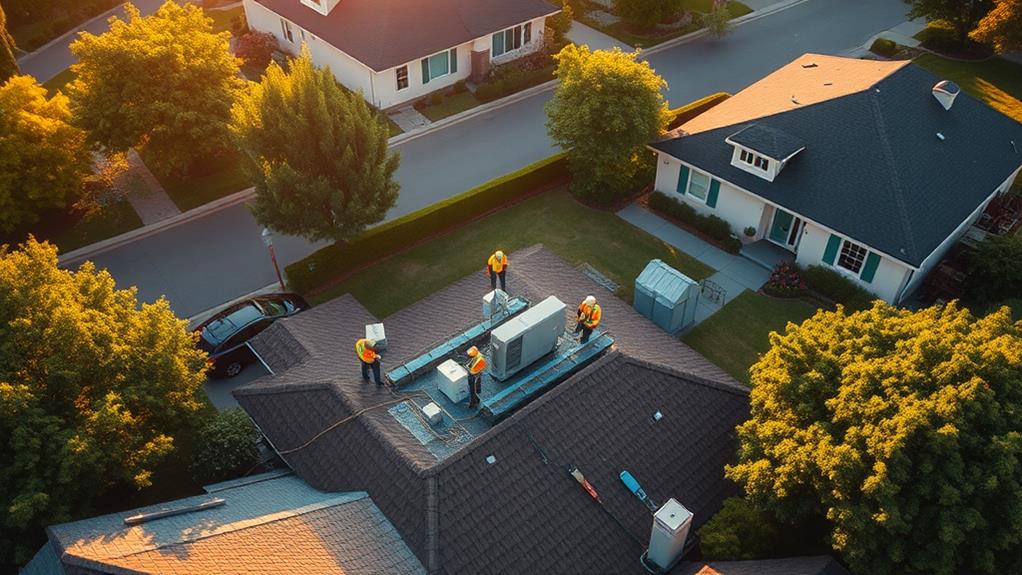
When planning the installation of your geothermal heat pump, timing is essential; scheduling it during off-peak seasons, typically spring or fall, can greatly reduce labor costs due to lower contractor demand. Many contractors are more willing to offer discounts and flexible pricing during these periods, as their workloads are lighter, which can result in quicker permit approvals and minimized competition for necessary equipment. Additionally, choosing an installation time when the ground is less likely to be frozen or saturated not only simplifies drilling and excavation processes but also guarantees a smoother shift to your new system, ultimately leading to a more cost-effective installation.
Timing and Seasonal Considerations
Planning your geothermal heat pump installation during off-peak seasons can lead to significant cost savings and a smoother experience. By strategically choosing your timing, you can enjoy:
- Lower labor costs: With reduced demand, installation crews are often more available and competitively priced.
- Fewer complications: Milder weather during late fall or early spring minimizes excavation challenges, reducing potential drilling expenses.
- Access to seasonal discounts: Many contractors offer promotions during off-peak times, allowing you to save even more on your installation.
Cost-Saving Installation Strategies
To maximize savings on your geothermal heat pump installation, timing your project for off-peak seasons can make a substantial difference. Scheduling your installation during late fall or early spring often results in lower labor costs, as demand for installation crews diminishes. Not only can you take advantage of discounts or promotions offered by contractors enthusiastic to fill their schedules, but you can also benefit from quicker project completion due to reduced overbooking. Off-peak installations minimize disruption to your daily routine, allowing contractors to allocate more resources to your project. In addition, improved material availability during these times may lead to lower prices, as suppliers often provide discounts to clear inventory. Implementing these cost-saving installation strategies, alongside a careful cost-benefit analysis, can greatly enhance your overall savings.
Explore Financial Incentives

Exploring financial incentives can still make a considerable difference in the affordability of geothermal heat pump installations, even though the landscape has shifted. According to the IRS, the Residential Clean Energy Credit (Section 25D) equaled 30% of qualified costs for systems installed from 2022 through December 31, 2026 — but under the One Big Beautiful Bill Act, that residential credit is no longer available for systems placed in service in 2026 or later. If your installation was completed and placed in service by the end of 2026, you may still be able to claim the 30% credit on your return using IRS Form 5695. For projects going forward, here’s what to look into instead:
- State-level tax credits and rebates, which vary widely — some states still offer meaningful credits for geothermal installations, so check our state-by-state incentive guide.
- Utility company rebates for energy-efficient geothermal systems, which many providers continue to offer regardless of federal credit changes.
- Business and third-party ownership structures, since the commercial geothermal credit under Section 48E follows a different phase-down schedule than the expired residential credit — a licensed tax professional or the DSIRE database can clarify what still applies to your situation.
Researching available incentives early in the installation process is essential, as programs change frequently and some have limited funding or specific deadlines. By taking advantage of whatever financial incentives remain available in your area, you can make your shift to geothermal heat pumps more achievable and affordable.
Invest in Quality Equipment
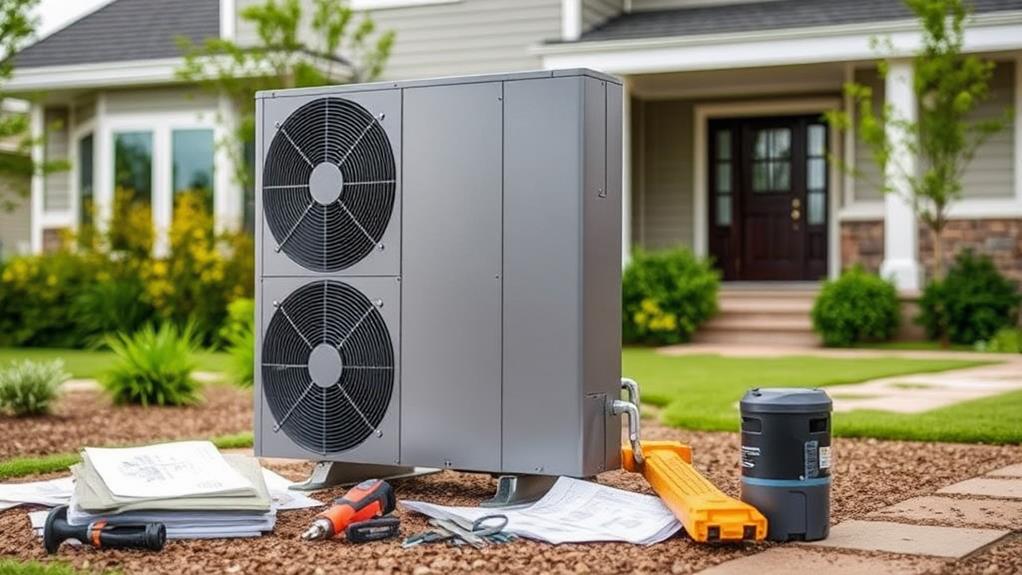
With the federal residential tax credit no longer easing the upfront cost the way it once did, the long-term benefits of your geothermal system hinge even more heavily on the quality of the equipment you choose. Investing in high-quality geothermal heat pumps, with equipment costs commonly cited in the range of $4,000 to $7,000 before installation, often results in better efficiency and lower operational costs over time. High-efficiency models, typically ENERGY STAR certified, are engineered to move several units of heat energy for every unit of electricity consumed — you can compare current certified models on ENERGY STAR’s official site. Additionally, quality equipment reduces maintenance needs and extends system lifespan; industry sources commonly report that properly installed ground loops can last several decades, often cited at 25 years or more, and in many cases beyond 50 years, while indoor heat pump units typically need replacement or major service sooner. While the initial heat pump cost may be higher, the return on investment (ROI) from energy savings is generally realized over a period of years, ensuring long-term satisfaction and freedom in energy management. Pairing your system with a home energy monitoring device can help you track those savings in real time.
Recommended Products

Energy Savings - Advanced algorithms optimize heating and cooling cycles, reducing energy consumption and lowering utility bills. Global Control - Control from anywhere,...
Consider Long-Term Maintenance
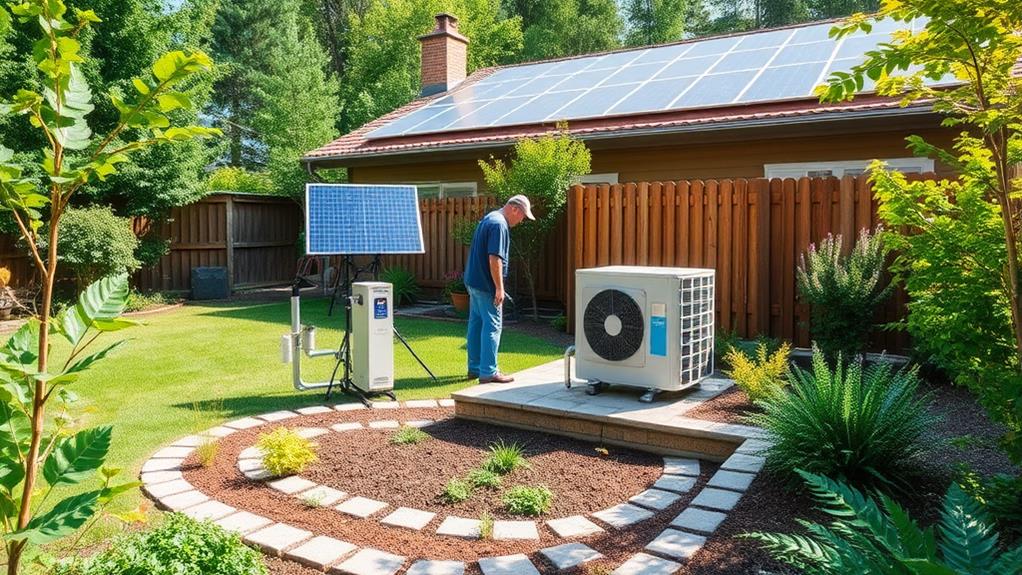
When it comes to geothermal heat pumps, considering long-term maintenance is essential for maximizing your investment. Proactive maintenance not only extends the lifespan of your heat pump unit but also helps you avoid unexpected costs down the road.
Here are three key aspects to focus on:
- Routine Checks: Regularly inspect coolant levels and ground loops to prevent leaks.
- Air Quality: Clean or replace air filters and ducts to enhance airflow, improving efficiency and reducing energy consumption considerably.
- Annual Service: Schedule yearly inspections with qualified technicians to identify issues early, minimizing the risk of costly emergency repairs.
For a deeper checklist, see our maintenance best-practice guide, much of which applies to any home renewable energy system.
Assess Site-Specific Conditions
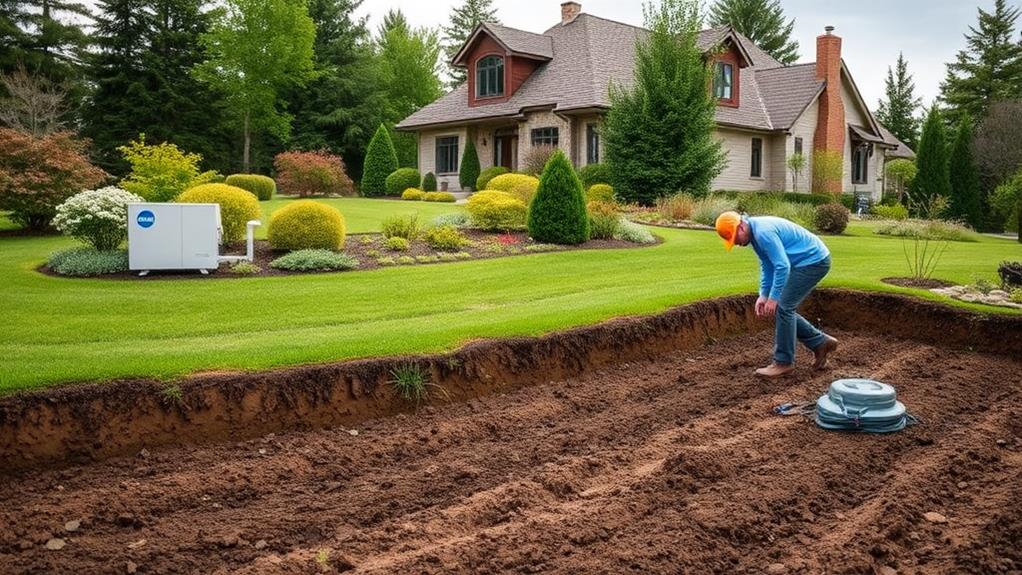
Evaluating site-specific conditions is essential for the successful installation of a geothermal heat pump. Begin with a geological assessment to understand how soil type and moisture levels affect installation complexity and costs. Accessibility for heavy machinery is another significant factor; challenging terrain can lead to increased labor expenses. The design of your system will depend on determining the depth and length of ground loops, which for vertical systems can run as deep as 400 feet, based on your home’s heating and cooling load. Additionally, consider the proximity of the ground loop to your home, as longer distances can escalate piping costs. Finally, identifying any excessive water issues early on is critical, as they can complicate drilling and inflate installation expenses.
Comparing Installation Cost Factors
| Loop Type | Typical Installed Cost Range | Best Suited For |
|---|---|---|
| Horizontal closed-loop | Generally the lowest cost of the closed-loop options | Properties with ample land and easy trenching access |
| Vertical closed-loop | Generally higher due to drilling to depths of up to 400 feet | Smaller lots or where land disturbance must be minimized |
| Pond/lake closed-loop | Can be the most economical when a suitable water body is available | Properties adjacent to a pond or lake of sufficient size |
| Open-loop (well/groundwater) | Varies with well conditions and local water regulations | Sites with an adequate, code-compliant groundwater supply |
Whole-project costs — including the heat pump unit, ductwork tie-in, and ground loop — commonly fall between $10,000 and $30,000, with more complex vertical or larger-tonnage installations reaching up to $45,000, according to current industry cost guides. If you’re weighing geothermal against other renewable options for your property, our comparison of green energy versus fossil fuel costs can help put these numbers in context.
Frequently Asked Questions
What Is the Average Cost to Install a Geothermal Heat Pump?
Installing a geothermal heat pump typically costs between $10,000 and $30,000 for a full system, with larger or more complex projects reaching up to $45,000. Installation factors like system size, loop type, and local labor rates can affect your financing options and the pace of your energy savings.
Is the Federal Tax Credit for Geothermal Heat Pumps Still Available?
The 30% federal residential credit under Section 25D applied to qualifying systems placed in service through December 31, 2026. Under the One Big Beautiful Bill Act, that residential credit is no longer available for systems installed in 2026 or later, though state incentives, utility rebates, and separate business-related credits may still apply — check the DSIRE database for what’s currently available where you live.
How Can We Reduce the Cost of Geothermal Energy?
You can reduce geothermal energy costs by exploring remaining state and utility financial incentives, using efficient installation techniques, comparing multiple contractor quotes, and enhancing your home’s overall energy efficiency. These steps not only save money but also promote sustainable living.
How Much Does Geothermal Energy Cost to Maintain?
Geothermal system maintenance costs are generally modest compared to installation, primarily covering periodic filter changes, coolant checks, and annual professional inspections. Investing in routine care boosts energy efficiency and helps guarantee system longevity, saving you money over the long run.
What Is the One Bad Thing About Using Geothermal Heat Pumps?
One notable drawback of geothermal heat pumps is the high upfront installation cost, which can run into the tens of thousands of dollars before any incentives are applied. Even though their long-term energy efficiency offers substantial savings, the initial investment and site-specific installation challenges are worth weighing carefully before committing.


